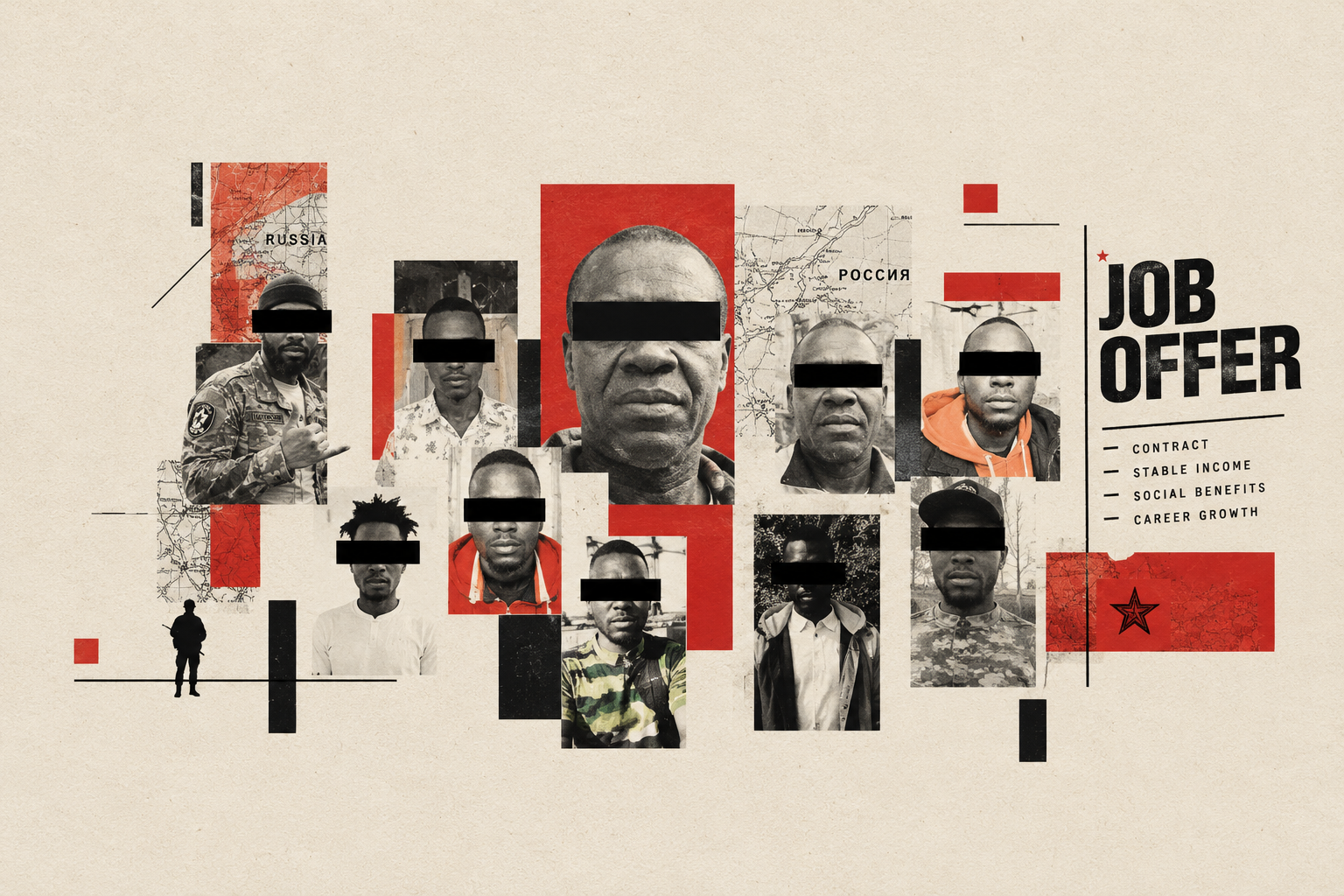
In February 2026, INPACT/AEOW exposed the networks recruiting Africans into the Russian Army, sparking widespread international media coverage. We hoped that the revelations would lead to change. They haven’t. Human Networks is our new investigative series, following the people, intermediaries and recruitment networks behind the trafficking of individuals into the Russian Army.

In February, AEOW/ INPACT published “The Business of Despair”, an in-depth report exposing the informal networks of visa agencies, recruitment firms and influencers that were channeling Africans into Russia’s war machine. The report, based on leaked databases from the war in Ukraine, listed 1,417 nationals from African countries who had been recruited by Russia, including more than 300 killed in action.
The increasing exposure of Russia’s foreign recruiting for the war in Ukraine had strained relations between Russia and many countries in recent years, including allies. Images from the frontline of dead or captured recruits, testimonies from POWs, numerous reports of people tricked or forced into fighting, and pressure from the families of the many missing recruits have corralled governments into a public response.
Multiple countries have raised the issue in bilateral discussions with Russia and sought assurances that their citizens would not be recruited, with apparently limited success. For example, in March 2026, following a meeting with Russian Foreign Minister Sergei Lavrov, Kenya’s Foreign Minister declared Kenyan citizens “were no longer eligible to be enlisted”. Lavrov was more circumspect, stating only that all foreign fighters had joined voluntarily ”in full compliance with Russian law”.
Unofficially, recruiters have apparently been given a ‘blacklist’ of countries to avoid. In January 2026, iStories noted a list was circulating among recruiters showing 36 countries whose citizens were banned from signing contracts with the Russian Armed Forces from 2026, covering many African nations and key partners for Russia, such as China, India, Brazil, Turkey, Cuba, Iran, and Venezuela. A subsequent unofficial list circulating in February expanded the list to encompass 43 nations, adding Argentina, Iraq, Yemen, Cameroon, Colombia, Libya, and Somalia.
However, evidence from the frontlines, the testimonies of POWs and open-source research shows citizens of those ‘banned countries’ continue to be enlisted for Ukraine. Whether the blacklist was genuine and poorly enforced – or merely disinformation to suggest Russia was backing away from certain countries – is open to debate. Indeed, the number of foreign fighters increased by more than 30 per cent between September 2025 and February 2026, according to an in-depth study by FIDH, released in April 2026, while Ukrainian intelligence has identified plans to recruit an additional 18,500 foreign nationals by the end of 2026.
Open-source research by INPACT/AEOW shows the same tactics of recruitment are ongoing and evolving, and apparently expanding into new geographies as Russia seeks to replenish its ranks.
Foreign fighters still appearing on the frontline
Despite purported “banned lists” and vague promises, African and other foreign nationals continue to show up on the frontlines in Ukraine. Throughout 2026, Ukrainian intelligence and news outlets have reported on cases of foreign recruits captured or killed in the war, including soldiers from Kenya, Nigeria, Sierra Leone, Cameroon and Mauritius, and a growing contingent from Latin American countries, among others. In almost all cases, the victims were recruited in 2026 and received a short period of training before being sent to the frontlines.

Searching Facebook, it is easy to find recently enlisted international recruits that are going or have gone through this pipeline. One example is Nhlanha Gumede, a man in his mid-20s from Bulawayo, Zimbabwe. He travelled to Russia in late June 2026, flying from Addis Ababa to Dubai (FZ642), then from Dubai to Moscow (FZ989). These split journeys are common for international recruits and may work to stymie efforts by target countries at borders to stop potential recruits traveling directly to Russia.

The first visible evidence of his enlistment is on 7 August, when he posts a photograph in military gear and another with drone equipment. In August and September, he posts multiple videos and photographs of him in gear with other Russian soldiers, as well as hosting several FB lives where he talks about his experience.
A clip from 13 September shows him eating sushi in what appears to be a semi-permanent base in a relatively safe location, with the flag of Russian naval infantry (marines) visible in the background, suggesting he is part of that structure.

He appears to have moved closer to the frontlines by early October. On 9 October, he held a FB Live where he said, “soon I will be going on my mission”, warning his viewers “it’s not a child’s playground… its serious”. Responding to a viewer’s question, he says the threats they face are “dealing mostly with drones and modern artillery”, adding “that’s what we’re dealing with over this side”. By 12 October, he appears close to the active combat zone. A short clip shows him jogging between two buildings, suggesting a drone threat.
While it is not immediately possible to ascertain his specific unit, Russian milbloggers reported that elements of the 40th Naval Infantry Brigade were credited with the claimed seizure of Mykilske, Donetsk Oblast, on 11-12 October.
Other countries that had supposedly secured assurances that recruitment had ceased also continue to see their nationals appear on the frontlines for Russia.
India, a G7 member state and a strategic partner for Russia, was one of the first countries to publicly raise the recruitment issue at the highest levels. In July 2024, Indian Prime Minister Narenda Modi raised the topic during talks with Putin in Moscow, leading Russia to promise to early discharge all Indian nationals serving in the Russian army. Nevertheless, over a year later, in September 2025, India again asked Russia to cease recruiting its nationals and return those serving, with the Russian Ambassador to Delhi stating recruitment of Indian nationals had actually ceased in March 2025.
At present – in October 2026 – India has said it is seeking information on 69 Indians still serving with Russian forces, with a total of 259 nationals believed to have been recruited – 139 now discharged early and 51 killed. Meanwhile, reports continue to come in of more Indians dying or in trouble on the frontline.

Online marketing continues
Gumede’s Facebook account is one of a number of profiles shared by accounts promoting recruitment in the Russian military. For example, one account “Sugar Boyza”, which was set-up in July 2025 and claims to be Botswana-based, links to Gumede as well as recruits from Nigeria, Colombia and Bangladesh, in addition to posting adverts to join the Russian Army, linking to Facebook Messenger and WhatsApp chats.

The recruits’ accounts present a positive vision of life in the Russian army have a notable number of followers with several providing Russian contact phone numbers and links to companies to arrange Russian visas and travel. It is notable that several of the accounts have very similar content and timelines, with clips showing training, camaraderie with other international and Russian recruits, and limited if any frontline action. Their experiences are at odds with accounts of many foreign recruits, where the average life expectancy upon enlistment is 150 days. It is possible these accounts and the soldiers are intended purely to market recruitment to foreign audiences and the soldiers deliberately kept away from heavy fighting.

The use of international recruits to on-sell the Russian army to potential recruits through social media has been widely documented by INPACT/ AEOW and other researchers. They are one part of the informal ecosystem that helped market the offer, with local visa and employment agencies handling the practicalities of getting potential recruits to Russia, either as willing recruits or through deceptive practices, such as false job offers.
It is clearly continuing, despite efforts by tech platforms to clamp down on online recruitment. Cursory searches of Facebook and TikTok surface adverts and pages for recruitment into the Russian army into job-seeking forums.

Dedicated pages for recruitment appear to generally be short-lived pages, featuring posters or images of foreign recruits with people expressing any interest in comments. While these groups and posts may appear random, research by iLAB, the technical investigations team of Code for Africa and partners, has identified complex networks of digital assets that can be traced back to the same recruitment organisations.
The network they investigated included 197 websites or web pages (75 apex domains, 104 subdomains and 18 platform-hosted pages), many Al-built as disposable ‘burn-and-replace’ assets, alongside 19 social-media accounts or Facebook pages, and 73 messaging accounts or channels across WhatsApp, Telegram, VK and MAX. While platforms such as Meta have taken down some of the accounts, they are quick to respawn.

How has Russia adapted to recruitment challenges?
Making use of internal resources
With increased scrutiny of recruitment networks in foreign countries, and a clampdown by some African governments on visa and recruitment agencies, Russia has reportedly looked to increase recruitment from foreigners already in-country.
A recurring pattern identified in our report (and others) is the targeting of foreign individuals within Russia on short term work or study visas who often must renew visas to continue their stay. Individuals run into visa issues in the process and are left with a simple choice of prison or joining the Russian army. It appears Russia has now fully codified this as a tactic: according to Ukrainian Intelligence (DIU), authorities within Russia were given specific quotas to recruit between 0.5% and 3.5% of the total number of foreigners in each region for the war against Ukraine.
The DIU suggested there would be a particular focus on citizens of Central Asian countries – Kazakhstan, Kyrgyzstan, Uzbekistan and Tajikistan – who have long made up a significant part of Russia’s manual labour force and come with the advantage of (mostly) speaking Russian.
There have been numerous reports of other foreign nationals enlisted through this tactic, including many citizens of African countries, an Iranian photographer, a Moldovan who had lived with his Russian family in Russia for many years, and Nathan Stobbart, a British man who moved to Russia in late 2024 to marry, and was then threatened with deportation unless he joined the army. He has been missing since December 2025.

The use of this tactic highlights the real risk for any foreigner undertaking work or study opportunities within Russia, which are still widely and openly advertised by agencies in multiple countries that have seen citizens forced into Russian army. The Kremlin too is apparently keen to ensure a steady flow of foreigners into the education sector, allocating over 10 billion rubles to quotas for foreign students and emphasising that African students were a priority. Russian authorities claim there are 37,000 African students currently studying at its universities.

Pursuing new markets?
Alongside deepening recruitment of foreigners already in Russia, it appears the Kremlin is also reaching into new countries to supplement its ranks. Having historically focused on Central and South Asia and Africa, it has increased recruitment from Central and South American nations, with Cuba and Colombia reportedly the hubs, and cases reported elsewhere, including Peru, Argentina, Brazil, Honduras and Paraguay. According to the Ukrainian organisation Hochu Zhit (“I want to live”), in the first nine months of 2026, four times more citizens of Latin American countries were captured than in all previous years combined.
Cuba has been a known and significant contingent in the Russia army since at least 2023. Reporting in October 2025 said Ukrainian military intelligence estimated more than 20,000 Cubans have been enlisted, warning that it could soon overtake North Korea as the main supplier of manpower to Russia. US intelligence put the number at up to 5000, in a cable released around the same time.
A study released in November 2025 by Carolina Barrero for the Friedrich Naumann Foundation for Freedom suggested recruitment from Cuba was approximately 60% of civilian workers deceived with false promises of construction employment, and 40% of military and intelligence personnel deliberately deployed. This echoes the situation in most target countries, with a mixture of willing recruits and those pressured or deceived into enlistment, although the percentages may vary significantly.
While the in-depth study by FIDH did not find systematic and structured recruitment outside of Cuba, there is now a steady wave of reports and pleas from families over missing loved ones, suggesting a growing problem in Latin America.
Reporting from CNN in June 2026 and later Politico in September highlighted multiple cases in Peru, where the country’s public prosecutor is looking into 36 complaints from family members over an alleged human trafficking network that lured citizens with false promises of employment in Russia, only for them to end up on the frontline in Ukraine. A spokesman for Peru’s foreign ministry told CNN the Peruvian government had made almost 250 separate requests to Moscow for information on citizens fighting for Russia and demanded their immediate safe return.
Open-source material highlights the scale of the problem. Facebook groups such as “Latinos en Rusia”, and dedicated campaigning pages including “Familiares desaparecidos en Rusia y Ucrania” and Camino a Casa, feature a constant stream of cases and testimonies of family members whose relatives have gone missing while fighting for Russia.


Several posts reference recruitment through an organisation called Jaguar Consulting (later renamed to Bears Consulting). An investigation by Colombian outlet Noticias Caracol found Jaguar had promised recruits a $35,000 bonus and monthly salary of $3,500, in addition to the promise of the Russian citizenship for the combatant and his family after six months of service. Other cases cite deceptive job offers or vague opportunities for security roles, where the individual travelled to Russia and then signed a contract, unaware they were enlisting in the Russian army.
It is worth noting that Ukrainian forces make heavy use of Colombian mercenaries, although there has been no suggestion of deceptive recruitment practices on behalf of Ukraine. Nevertheless, Facebook groups and Telegram channels also feature frequent posts of foreign recruits missing or wounded while fighting for Ukraine.

The strength (and weakness) of informal recruitment networks
In our February report, we highlighted the resilience of the informal recruitment networks being utilised by Russia: a myriad of small visa and employment agencies and accounts across a range of platforms were being used to market and funnel potential recruits into Russia.
Like other aspects of Russia’s hybrid war effort, this networked system allows Russia to maintain a degree of deniability and continue to recruit from countries where they have officially said they have stopped – “these people are nothing to do with us”. The informal and networked nature also makes it extremely difficult to prevent. It is possible to clamp down on identified agencies or influencers – as happened in Kenya and South Africa – but there is little to stop new agencies and accounts taking their place, particularly if the financial incentives remain.
However, this strength is also a significant weakness: Russia’s reliance on unofficial and unacknowledged channels creates a credibility void, which can be easily exploited by other actors. There are claims are under some recruitment posts that they are a scam, presumably to harvest potentially valuable information, such as passports, or take money for fake processing or transport fees.
The same credibility gap can – and may already – be exploited by counter-recruitment campaigns, accusing real posts and agencies of being a scam, or establishing numerous fake recruitment channels to crowd the market and frustrate potential applicants, ultimately undermining faith in the informal recruitment process and greatly reducing its effectiveness.
Conclusion: Defund Recruitment Networks
Despite protests by target countries, local clampdowns on nefarious visa and employment agencies, and vague pledges from Russian officials to cease recruitment, all the evidence suggests Russia’s informal ecosystem of recruitment is continuing, adapting, and growing into new markets. Foreign fighters from around the world continue to show up on the frontlines, either as willing volunteers in search of quick money, or duped and coerced into the armed forces.
The efforts of local authorities and tech platforms can have a temporary effect in disrupting the networks, but as long as the financial incentives remain for recruiters and potential recruits, the ecosystem will quickly recover and continue.

Leave a Reply