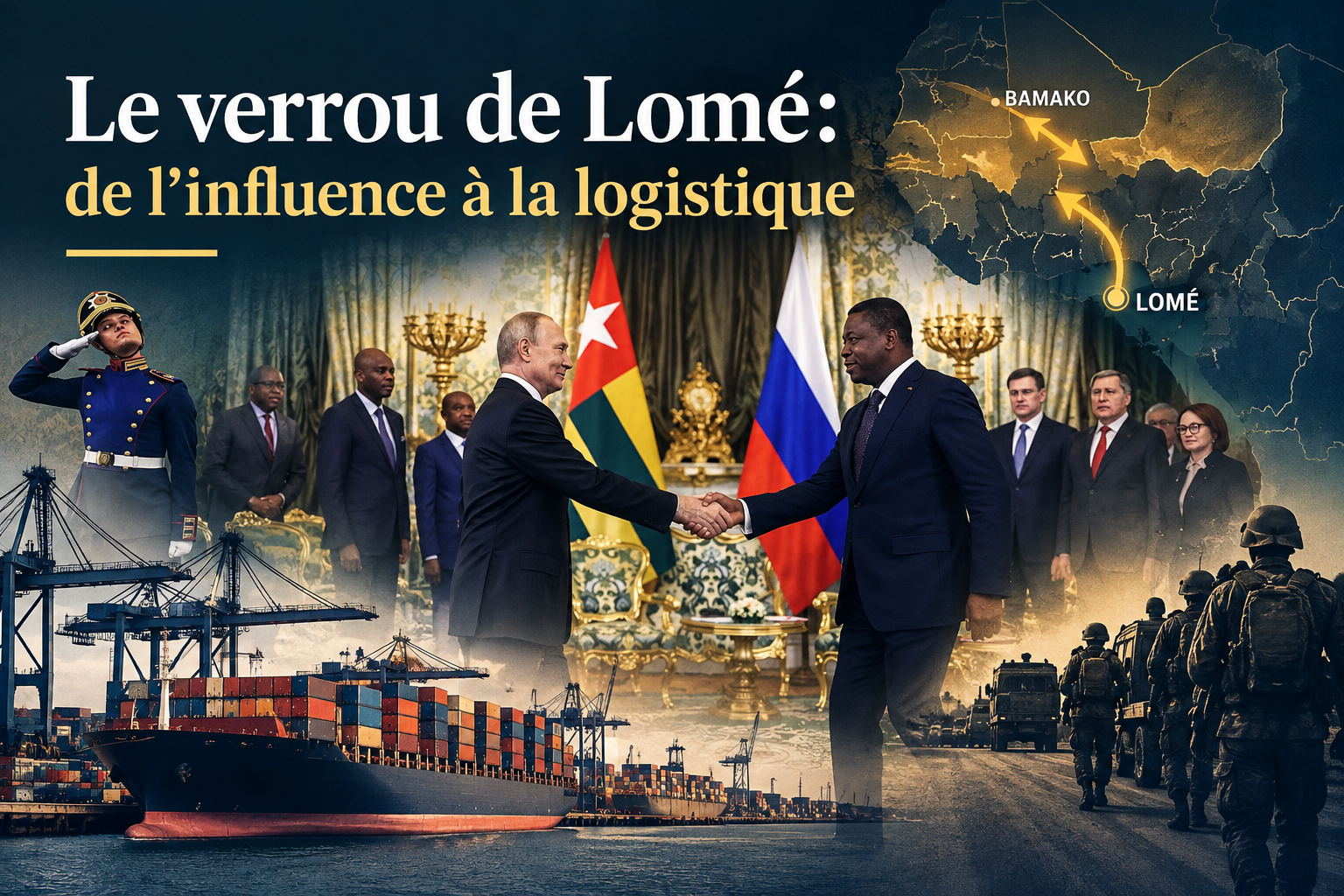

In eighteen months, between March 2025 and July 2026, the Russia-Togo relationship has gone from a dormant diplomatic tie without resident embassies to a security partnership backed by a ratified legal framework, a maritime component and concrete logistical follow-through.
The Port of Lomé is the real object of the relationship. With a draft of 17 metres, West Africa’s leading port for transit traffic and a supply hub for the landlocked Sahel: it is this port platform, not Togo’s domestic market, that makes the country a priority target for Moscow.
The military agreement between the two countries, signed on 27 March and 3 April 2025, ratified by the Duma on 7 October and promulgated on 15 October 2025, provides for joint exercises, training, intelligence sharing and reciprocal use of military port facilities.
Everything suggests that the docking of the sanctioned cargo ship Mikhail Britnev on 9 July 2026, followed by the passage of an armoured convoy toward Mali on 23 July, opening a corridor Lomé–Bamako, marks the point at which this cooperation became operational.
The Togo-Russia agreements are part of a broader realignment of alliances in West Africa, marked by the relative decline of French and American influence and the rise of alternative actors such as Russia, but also China, Turkey and the Gulf states.
These agreements risk deepening fault lines within ECOWAS and between coastal states still anchored to Western partners (France, the European Union, the United States) and states shifting toward Russian security partnerships, or even toward the AES.
From a Dormant Relationship to a Structured Partnership
The bilateral relationship had long been an empty shell. In 2024-2025 the two countries marked the sixty-fifth anniversary of their diplomatic relations without either having a resident mission in the other, as Vladimir Putin himself noted at the Kremlin in November 2025, announcing the reciprocal opening of embassies from 2026. Contacts do exist: the visit of special representative for Africa Mikhail Bogdanov to Lomé in 2018, Faure Gnassingbé’s trip to Russia in 2019, and the November 2024 visit of Deputy Minister Yunusbek Yevkurov and Lieutenant-General Andrei Averyanov to Lomé with Togo’s Ministry of Economy.


The acceleration begins with the signing, on 27 March 2025 in Lomé and then on 3 April in Moscow, of a framework military cooperation agreement. The Russian process then follows a public timetable: approval by the government legislative commission on 22 July 2025, ratification by the State Duma on 7 October, promulgation by the Russian president on 15 October, for a text of indefinite duration.
Faure Gnassingbé’s state visit to Moscow on 18 and 19 November 2025 marks the political turning point. The first face-to-face meeting between the two leaders in six years, it officially covers diplomacy, trade, agriculture, energy, training and food security, and concludes with the announcement of the opening of reciprocal embassies. 2026 will see the visit of Russian Defence Minister Andrei Belousov to Lomé on 8 and 9 March, along with the signing of a maritime and logistics protocol in April, and confirmation by Sergei Lavrov, in early July, of the opening of the Russian diplomatic mission in Lomé, becoming one of four new African embassies announced, which would bring Russia’s network on the continent to forty-nine posts.
A Documented Targeting Effort Since 2023
This trajectory confirms that Russian interest in Togo is not new: the country has long been regarded as a strategic target.
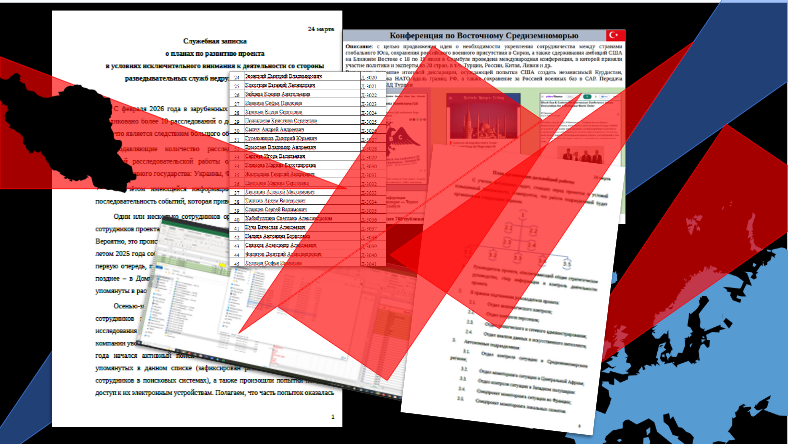
As early as 2023, the country appears on the list of African countries where Politology operates — the former influence branch of the Wagner Group, taken over by the SVR after the death of its founder Evgeny Prigozhin. Documents obtained by The Continent and shared with a media consortium that includes INPACT show that Politology identified three main objectives: controlling a logistics platform in West Africa, influencing the local phosphate market, and discrediting France on the ground. A year later, a campaign was launched on the ground as part of Africa Politology’s operations. The actions carried out in Togo revolve around continuous media monitoring, the production of strategic briefs, and the development of field activities combining intelligence-gathering from opinion leaders with the mobilisation of youth networks.

In May 2025, Faure Gnassingbé — in power since 2005, and whose family has ruled the country since 1967 — was re-elected and steered the country toward new alliances.
The Port as a Bargaining Chip
The Autonomous Port of Lomé is where the value of the relationship is concentrated. It handles about 90% of the country’s trade and generates roughly 75% of tax revenue. The Russian ambassador explicitly highlights its 17-metre draft — about twice that of Cotonou — which allows it to receive high-tonnage vessels.
What Russia is after above all is a port logistics platform. The project, publicly described by the Russian ambassador, would turn Lomé into a transshipment point from which Russian ships would serve West Africa and the landlocked Sahel states. In March 2026, the Togolese Chamber of Commerce and the Russian trade mission identified three priority sectors — food security, mining, and energy — with the stated ambition of moving beyond simple goods exchange to create joint industrial ventures.
The internal documents uncovered during our investigation with the “Propaganda Machine” consortium explicitly identify Togo’s phosphate industry as a target for approach — this mineral remaining the main driver of Togolese exports, which grew by 29.5% in the second quarter of 2026.
In February 2026, the port of Lomé was chosen to ship 20,000 tonnes of mineral fertiliser donated by Russia to Niger, following a week-long Nigerien mission to Lomé dedicated to mapping the logistics chain.

Alongside the signing of a maritime and logistics memorandum of understanding in April 2026, in the wake of Togo’s participation in an international transport forum, Togolese companies were encouraged to take part in Russia-Africa business forums.
Bilateral trade volume remains low, consisting mainly of fertiliser, grain and Russian industrial goods; authorities in both countries present the opening of embassies as the expected trigger for a step-up.
One conclusion stands out at this stage: the economy is not the driver of the relationship, it is its packaging and its promise. The real driver is logistics and security.
That said, the port of Lomé is being courted simultaneously by numerous players, which limits Russia’s ability to secure an exclusive position there. In late 2025 the European Union announced an investment of more than €12 million over four years to modernise and secure some ten West and Central African ports, including Lomé, through the SCOPE Africa project.
Turkey is preparing a memorandum establishing a logistics corridor between Lomé and Mersin, its leading container port, to gain a foothold in the Sahel; Turkish-Togolese trade has risen from $140 million in 2021 to around $270 million.
The United States, finally, has been assessing the site’s potential since July 2025 for its own operators.
July 2026: the US-sanctioned cargo ship Mikhail Britnev (IMO 9081370) docks at the port of Lomé. On board are military vehicles the ship loaded at the port of Baltiysk between 11 and 18 June 2026. After a voyage partly conducted with AIS switched off and under military escort from the Russian warship Aleksandr Shabalin, the cargo ship came to unload its cargo before it took the road to Bamako through Burkina Faso.


The military equipment is transported by road to Bamako, via Burkina Faso. This convoy also confirms the presence of Africa Corps members in Lomé, estimated at 300 personnel.
After unloading its cargo, and since 8 August 2026, the Mikhail Britnev (IMO 9081370) has been anchored off Lomé, reportedly bound on a return voyage to the port of Pevek in Russia.

The main risk of hosting sanctioned vessels is not military — it is reputational and financial. Receiving sanctioned ships exposes Togo’s port ecosystem to a risk of secondary sanctions and disengagement, even as 75% of the country’s tax revenue comes from maritime activity.
The domestic political stakes are real. The Russian sequence is unfolding against a backdrop of contestation of the Fifth Republic and an opposition demanding accountability over the presence of foreign forces in the Savanes region, with no public government response to date.
Reconfiguring Military Partnerships
Togo simultaneously maintains security cooperation with the United States, naval exercises with France, drone purchases and private cooperation with Turkey, and European financing for its port. The declared doctrine is one of « active non-alignment »
Since 2022, the country has faced incursions from Burkina Faso by groups linked to JNIM, causing attacks on villages and on military positions stationed along the border. Faced with this expansionism, Togo has set up military partnerships with Turkey and also with Russia, in addition to the 8,000 troops deployed under the declaration of a state of emergency in that region.

Turkey has been stationed since late 2023, notably at the Dihiaga base, one of a network of fortifications and forward posts along the border with Burkina Faso. These bases are located at Banangandi, Djibontoti, Niamtougou, Kpentindjoaga, Waldjouague, Nioukpourma and Mandouri, built by Burkinabè contractor EBOMAF.

The involvement of Turkish fighters in operations by the Togolese army was first revealed on 9 June 2025, when testimonies and photographs were published showing European-looking soldiers accompanying the Togolese army during operations in the village of Kpinkankandi, in Togo’s far north-east.

Turkey’s presence is also technological, with the deployment of Turkish Bayraktar drones observed at Niamtougou airport since late 2022.

Russia, for its part, has deployed around 300 men since January 2026, including about 200 fighters at the base of the 4th Infantry Regiment in Niampourma. The first deployments involved flights between Russia, Mali and Togo, with stopovers at Niampourma airport.

This foreign presence has prompted recurring questions from the political opposition.
Togolese authorities appear to want to deliberately limit these two partners’ role to training and intelligence, possibly to avoid seeing on their own soil a repeat of the abuses documented in Mali and the Central African Republic. As things stand, the only solidly established fact is the existence of a ratified legal framework and a documented logistics flow.
For Russia, buoyed by this stronger access to the port of Lomé — notably for its navy — Moscow now has a maritime bridgehead in the Gulf of Guinea, effectively enabling a foothold and the use of relatively secure overland routes into the various AES countries, where Moscow keeps troops deployed under the Africa Corps banner and holds strong ambitions for economic exploitation.
Togo, a Hinge Between the AES and ECOWAS
Togo has not joined the Alliance of Sahel States, whose treaty remains limited to Mali, Burkina Faso and Niger. But it has joined its functional orbit. Public debate over membership has been open since January 2025, when Robert Dussey called it “not impossible.” Since then, Lomé unveiled on 18 April 2026 a 2026-2028 Togo-Sahel Strategy built around five pillars: strengthened political dialogue, transport corridors, trade facilitation, and security cooperation including intelligence-sharing against jihadist groups, approved by all three AES states. Togolese troops have taken part in joint exercises with AES countries, notably the Tarhanakale exercises in Niger.
Togo’s calculation is twofold. Economically, the port of Lomé has become the main maritime gateway for Burkina Faso and Niger, at Cotonou’s expense. Politically, proximity to the AES offers Lomé alternative external legitimacy, in a space where questions of electoral democracy take a back seat to security imperatives. By staying outside the alliance, Togo retains a stronger port negotiating position and greater macroeconomic advantages.
Russia as an Accelerator of Realignment
What the “Propaganda Machine” investigation was able to document is an explicit objective: consolidating a pro-Russian AES and expanding it to neighbouring countries. Togo appears there as a “prospect,” its port described as a vital logistics hub from which French influence would need to be removed. The country is also among those targeted by 35 information campaigns said to have been run between February and April 2024, involving the distribution of 644 propaganda or disinformation articles in at least 35 West African media outlets, paid between $250 and $700 per article. These campaigns coincided with Togo’s legislative elections and its constitutional reform.
The subsequent sequence — the defence agreement, the Kremlin visit, the discreet reception of Russia’s defence minister — matches the approach plan described in these documents, though causality is not thereby proven: Togo’s pre-existing security needs alone could explain part of the rapprochement.
On the ground, the same dynamics already observed in AES countries or in the Central African Republic are under way, as seen on 18 March 2026 in Lomé with the inauguration of a mural marking the 65th anniversary of diplomatic relations between Russia and Togo. The mural was produced with the help of African Initiative, the influence network tied to the GRU that follows Africa Corps into countries where Russia is establishing itself. Located not far from the airport and visible from the access road, it is a further, powerful marker of the shift under way in Togo.


The generally positive perception of Russian action among Togolese populations places Togo in the upper range on the continent, alongside countries such as Mali and Cameroon.
Published in March 2026, a poll shows that 49% of Togolese respondents hold a positive perception of Russia’s political and economic influence in their country.

Russia is continuing its policy of multi-sector agreements, with the signing in late August 2026 of an agreement on academic cooperation. The number of Russian state scholarships awarded to Togolese students rose from about ten to 86 for the 2024-2025 academic year, and Faure Gnassingbé publicly thanked Moscow for this at the Kremlin.
What Effects on the Regional Architecture?
For ECOWAS, Togo occupies a mediating position between the organisation and the Sahelian regimes. Too visible a shift would cost it this usefulness and weaken the only remaining channel of dialogue between the two blocs.
For Gulf of Guinea countries, Russian port access sets a precedent that other coastal capitals could be tempted to follow, in a zone where hydrocarbons and containerised flows transit and where piracy remains a shared concern.
Within this framework of port competition, the shift of the arms corridor from Conakry to Lomé redistributes not only military flows but also logistics rents and political exposure, to the detriment of Guinea and, indirectly, Benin.
Faced with this development, the Western response has so far remained diplomatic and financial: a French ministerial visit, European port financing, and continued American intelligence cooperation, rather than sanctions or direct coercive measures against Lomé.
Yet the financial sector could be the area of effort that makes the difference for Russia in building a comprehensive approach to Togo. According to a report by the Centre for Information Resilience on the alternative payment system A7, a Russian Telegram channel called What’s Next claimed last March that A7 would play ‘a central role in the setup’ and was operating in Togo as a ‘financial and organisational platform’ to support Russia’s strategic interests in Africa, ‘in collaboration with the Belarusians.’ Indeed, one key figure has been decisive in bringing Togo and Russia together: Alexander Zingman, a controversial Belarusian businessman active in Africa. Last March, A7 was recruiting a country director for Togo.

Leave a Reply