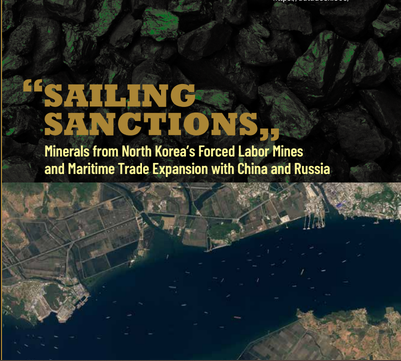

Our colleagues at 북한인권시민연합 – Citizens’ Alliance for North Korean Human Rights (NKHR) have published a significant new report entitled Sailing Sanctions: Minerals from North Korea’s Forced Labor Mines and Maritime Trade Expansion with China and Russia. The report brings together witness testimony, open-source intelligence and maritime analysis to examine how North Korea continues exporting coal and strategic minerals despite years of United Nations sanctions.
Produced in collaboration with Data Desk (UK), the report argues that the issue extends far beyond sanctions compliance. It presents evidence suggesting that North Korea’s mineral exports are deeply intertwined with state-imposed forced labour, sanctions evasion, and the financing of the country’s military and weapons programmes.
A supply chain built on coercion
According to the report, North Korea’s extractive industries rely extensively on forced labour. Drawing on interviews with former prisoners, former officials, former soldiers and descendants of unrepatriated South Korean prisoners of war, the authors describe a system in which political prisoners, military conscripts and socially marginalised populations are assigned to mining work under conditions that they argue amount to modern slavery.
The report highlights how coal, iron ore, zinc, lead and other strategic minerals are extracted through structures of coercion embedded within North Korea’s political and security system. It further argues that revenues generated from these exports contribute directly to maintaining the state’s security apparatus while supporting military procurement and weapons development.
Sanctions evasion through maritime networks
One of the report’s central contributions is its examination of how North Korea has adapted to international sanctions.
Using vessel tracking, satellite imagery and open-source maritime data, NKHR and Data Desk document a range of sanctions-evasion techniques, including:
- Automatic Identification System (AIS) manipulation;
- ship-to-ship transfers at sea;
- false vessel registration and ownership structures;
- origin laundering of coal through third countries;
- complex financial arrangements involving Chinese banking channels.
The report identifies 47 high-risk vessels allegedly involved in North Korea’s mineral trade, including both already-sanctioned vessels and additional ships displaying similar operational characteristics.
The authors argue that maritime sanctions evasion has become increasingly sophisticated, allowing North Korean exports to continue despite existing international restrictions.
China and Russia’s expanding role
A major focus of the report is the growing strategic relationship between North Korea, China and Russia.
The authors suggest that deepening political, economic and military cooperation between the three countries has created conditions that facilitate sanctions evasion. They point in particular to the end of the UN Panel of Experts’ mandate in 2024, increasing maritime activity between North Korean, Chinese and Russian ports, and the expansion of logistics and financial networks that may complicate efforts to monitor illicit trade.
Rather than describing isolated smuggling operations, the report presents what it characterises as an increasingly structured regional system through which sanctioned commodities can continue reaching international markets.
Linking human rights and security
One of the report’s principal arguments is that North Korea’s mineral exports should be understood through both a human rights and a security lens.
According to the authors, forced labour, sanctions evasion and weapons financing are interconnected components of the same political economy. Revenues generated through mineral exports not only sustain North Korea’s domestic repression but also contribute to its military capabilities and broader strategic ambitions.
This integrated approach encourages policymakers, financial institutions, shipping companies and supply-chain actors to consider sanctions compliance alongside human rights due diligence when assessing exposure to North Korean trade.
An important contribution to ongoing research
Sailing Sanctions combines testimonies collected over several years with extensive maritime analysis and open-source investigation. Beyond documenting sanctions evasion, the report provides a detailed examination of the relationship between mineral extraction, forced labour and regional geopolitical dynamics.
At a time when international monitoring mechanisms have become more limited, this work represents an important contribution to understanding the evolving mechanisms through which North Korea generates revenue under sanctions.
We encourage readers interested in North Korea, sanctions enforcement, maritime security, human rights and illicit trade networks to read the full report published by our colleagues at the Citizens’ Alliance for North Korean Human Rights (NKHR).


Leave a Reply