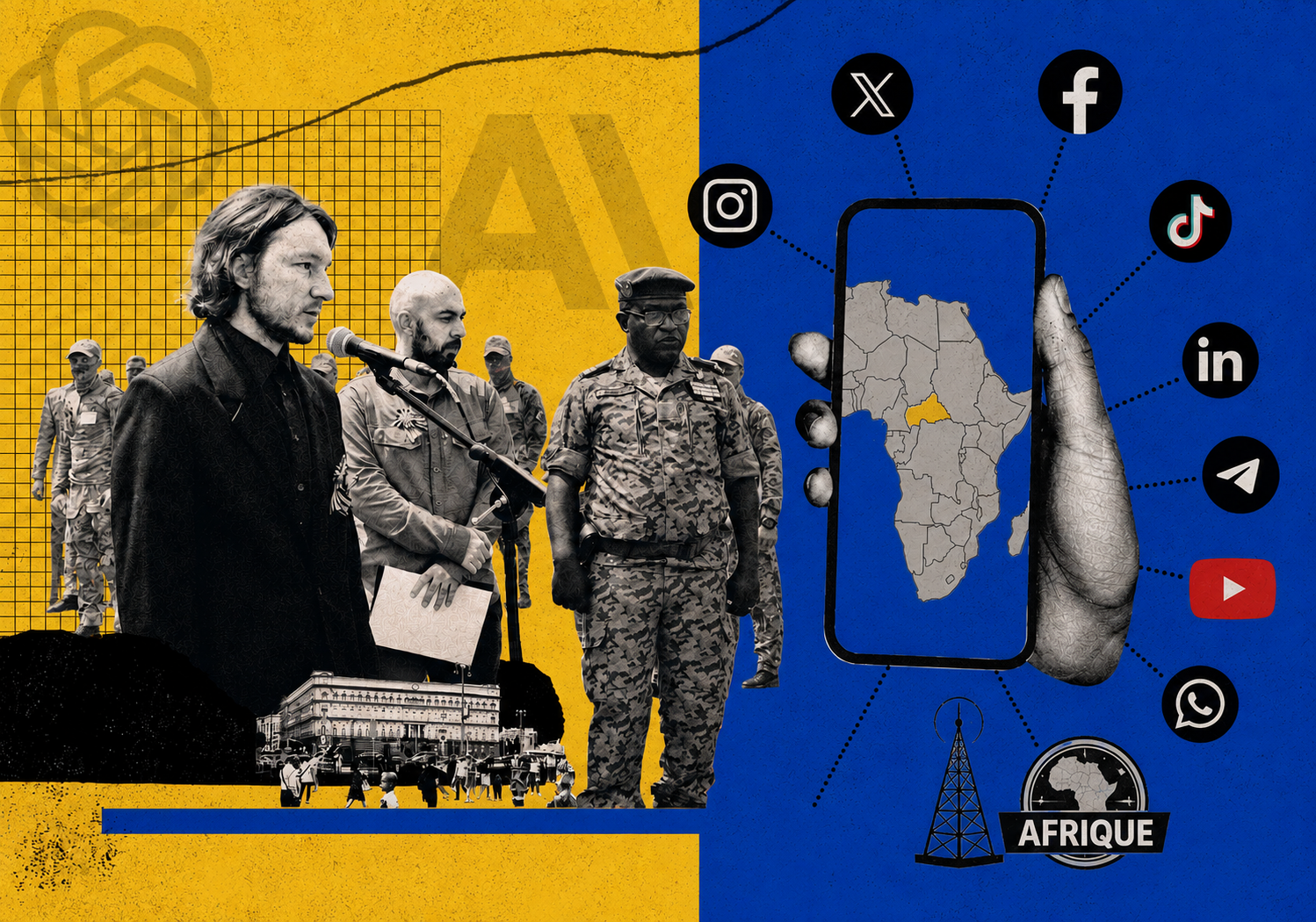

The address of a residential apartment in the heart of Madrid’s tourist district. Two invoices for ChatGPT and Claude. A Western name. At first glance, it could be any digital nomad. Yet, behind these documents lies Artur “Mirzoian” Tevosyan, one of the key figures of Politology in the Central African Republic—an organisation now controlled by Russia’s Foreign Intelligence Service (SVR) – and a hub of Russian influence operations in Africa.
This investigation reveals how Tevosyan, tasked with Russian influence campaigns in the CAR, utilised artificial intelligence tools from OpenAI and Anthropic in his work, highlighting the ease with which AI tools can be harnessed by hostile states and malign actors.
The devil is in the details
INPACT/AEOW obtained two recent invoices showing basic level subscriptions to OpenAI (ChatGPT) and Anthropic (Claude) AI tools. The invoices, from April and May 2026, were for monthly subscription fees, amounting to a little over €20 each.

The billing address provided is 45 Gran Vía in Madrid, Spain, a residential property on one of the capital’s main thoroughfares,where several apartments are available to rent to visiting tourists.

The invoices give two email addresses: “arthurnerimbaud [at] gmail [dot] com” and “arthurmrz69 [at] gmail [dot] com”. Cross-referencing these addresses and looking at other accounts associated with them leads to a single individual: Artur “Mirzoian” Tevosyan, who can be identified as the Politology coordinator in the Central African Republic and a key figure in the Russian network’s influence operations in the country.

Active in around thirty countries, Politology has become the Russian Foreign Intelligence Service’s (SVR) vehicle for influence across the Global South. In February 2026, INPACT/AEOW, in a consortium with several media outlets, published the first installment of an investigative series on “Politology,” based on an unprecedented leak of documents obtained by the pan-African outlet *The Continent*. The documents showed how, following the death of Yevgeny Prigozhin, Politology—the Wagner Group’s influence arm—came under the direct operational and financial control of the SVR.
The invoices obtained by INPACT/AEOW now offer a unique insight into the digital tools used by this influence network working on behalf of Russian intelligence.
OpenAI discovers a cluster of accounts used for Politology operations in the CAR
When we shared this information with OpenAI, the company was able to link these subscriptions to a group of ChatGPT accounts, some of which were now inactive. Their activity was far from innocuous.
According to an OpenAI representative: “They [these accounts] were primarily used for translation and summarisation—specifically of press reviews regarding the Central African Republic—as well as for open-source research”. OpenAI has suspended the accounts.
INPACT/ AEOW also shared the information with Anthropic, who confirmed receipt and have said they are investigating the account, but they have not provided any further information at the time of print.
The invoices add to a growing body of evidence of Russia’s use of Western artificial intelligence tools in influence operations in Africa. In February 2026, OpenAI revealed it had identified a ChatGPT user involved in producing content for several African countries, including South Africa, Ghana, Kenya, and Angola. The observed activities included drafting posts for social media accounts that had repeatedly changed their identities, as well as generating in-depth analytical articles on geopolitical dynamics in sub-Saharan Africa.
Some of these texts were attributed to a certain “Dr. Manuel Godsin”—a fictional persona for whom no credible trace could be found, according to Code for Africa, the organisation that investigated the campaign.

According to information provided by OpenAI, the prompts sent to the model were primarily in English. However, some included detailed instructions or comments written in Russian—framed as coming from a superior—suggesting a structured organisation behind the activity.
Anthropic has also previously identified misuse of its AI, Claude, for influence operations involving the activity and coordination of around a hundred social media accounts.
Harouna Drabo, an expert on information warfare and journalist, explained to INPACT/AEOW the role that artificifial intelligence is playing: “While saturating the information space with anti-Western disinformation narratives is the primary operating principle of Russia’s influence apparatus in Africa, generative artificial intelligence enables the industrial-scale production of such content. Its use significantly reduces the costs associated with mobilizing the human, technical, and logistical resources required to conduct these operations”.
Tevosyan’s trolling of France
There is another intriguing detail in the invoices. One of the OpenAI invoices is not addressed to Arthur Tevosyan but bears the name “David Denis”. Was this name chosen at random to throw investigators off the scent? David Denis does not appear on the lists of employees of Politology that INPACT/AEOW identified in previous investigations with Forbidden Stories and the Dossier Center.
But David Denis is not a random name. Denis was stationed at the French Embassy in Bangui for three months, from October 2025 to January 2026. He was targeted by a smear campaign in media outlets affiliated with Politology as of March 2026 —such as Radio Lengo Songo and Ndjoni Songo—as well as in regional African media.

These media outlets appear in Politology budget documents obtained during our investigative series on the network controlled by the SVR.


A French diplomatic source told INPACT/AEOW that the French Embassy staff frequently face disinformation attacks to undermine their work and presence in country. The Embassy routinely advises staff to seek official institutional protection and to pursue legal action where appropriate. Central African authorities are also systematically notified whenever articles containing disinformation regarding France and its representatives are published.
Using Denis’ name on the invoice for ChatGPT may have amused Tevosyan, but it also reveals a direct link to the SVR’s in-country influence operations against the French Embassy.
From France to Politology: The murky background of Artur Mirzoian Tevosyan
Before becoming Politology’s influence coordinator in the CAR, Artur Tevosyan lived in France for a long time. Born in 1998 in the Krasnodar region to Russian parents, Karen and Ilona, Artur Tevosyan’s background is difficult to piece together, with fragments emerging through numerous social media accounts with limited real information.

He has employed multiple identities, going by names such as Arthur Mirzoian and Arthur Miroy. From 2011 to 2015, he lived in Lyon, where he pursued higher education at Jean Moulin University Lyon 3. By 2015, he was in Paris, apparently studying at Paris-Sorbonne University. From June 2023 through to the end of 2025, Tevosyan ran his own company in Paris, providing translation services.


While living in France, he was also actively participating in Russian ultra-nationalist activities online, contributing to the Russian ultra-nationalist publication *Vandeya*. Under the pseudonym “Arthur Nerimbaud” (a play on words implying “Arthur Not-Rimbaud”), his efforts included translating a book about Emmanuel Macron by Laurent Obertone —an anti-liberal critic of the West—into Russian.

Online, Artur posts extremely violent images and is close to Russian ultra-nationalist circles.

Some of his comments on VK are racist and antisemitic: “Guys, it’s time to organize a new Black Hundreds. Jews and Blacks have completely lost their minds; they’re already starting to collaborate! Beat up the rappers, save Russia!” or “Next time, little Jew, we’ll kill you and that asshole too. Russia will be free!”. Black Hundreds is a reference to a monarchist, ultra-nationalist organisation that orchestrated pogroms in the early 20th century.
The subscriptions uncovered by INPACT/AEOW – and the information provided by OpenAI – show how Politology has been integrating Western AI tools into the everyday processes of their information operations.
Importantly, many of the simple tasks – media summaries and analysis, writing or translating articles, content creation – are not activities or prompts that would immediately trigger any safeguards, making it extremely difficult for platforms to identify and block. But when these steps are combined, AI tools can greatly accelerate the process of developing and implementing campaigns, becoming a critical component of the operational infrastructure of influence networks—on par with media partners, influencers, or social media account farms.


Leave a Reply