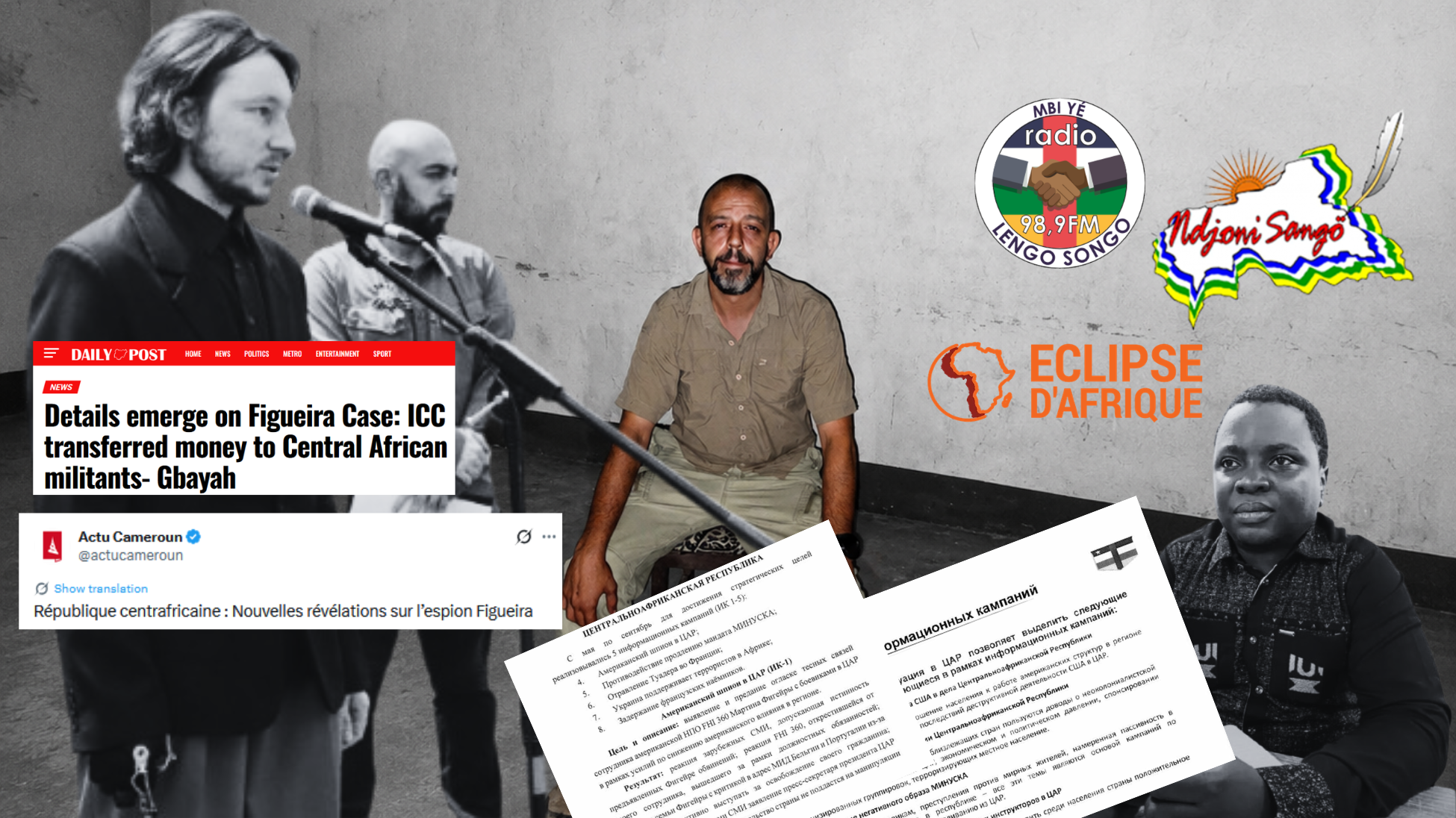

On May 29th 2024, Radio Lengo Songo, a radio created and funded by the Wagner Group in 2017, published the photo of a European man sitting on a stool, looking tired and wearing sand coloured traveling clothes and walking boots. The title was alarming: “An American spy arrested in Zémio in Haut Mbomou”. This article was the first one of a media storm in CAR and the region accusing Joseph Figueira, a Belgo-Portuguese national, working as a consultant for FHI360, an American NGO, of spying for the CIA and destabilising the country.
But the 1,400 pages of leaked documents from Politology – the ex-influence branch of the Wagner Group under the control of the Russian Foreign Intelligence Service (SVR) – obtained by The Continent and shared with a consortium of media partners tell another story. INPACT/AEOW and its partners can reveal how Figueira’s arrest was weaponised by Russia to undermine the West and serve the political elite’s interests in CAR. This article is about how Politology manufactures enemies from the international civil society and operates along with the Wagner Group a system of propaganda relying on local networks and ultra violence in CAR

Getting rid of the West in CAR at all cost
Going after France and the US
As the SVR took control of the Politology network in December 2023, its most docile ally, the Central African Republic used by the Wagner Group as a testing ground for influence operations, state capture and economic predation, moved towards diversifying their security partnership with the United States. Since December, Bancroft, an American private military company, had arrived in the country following a security deal signed with the CAR authorities.
For Politology, the strategy for CAR became very aggressive to defend Russia’s interests, no holds were barred. CAR accounted for the biggest budget lines in Politology’s accounts with 1,525,105 USD dedicated to influence (media, influence) from January to October 2024. Documents dated February 2024 described four strategic areas of work for information campaigns crafted by Politology: 1) exposing and criticizing US interference. Here the objective was to expel Bancroft at all cost, 2) Criticizing French actions systematically portraying them as .neocolonialist, supportive of paramilitary groups and pressuring; 3) Creating a negative image of the MINUSCA to push for their removal from the CAR and 4) organisating a positive coverage of Russian instructors to strengthen the image of Russia.


In order to achieve these objectives, Politology does not hesitate to try to create rifts between the US and France by running campaigns pushing the idea that the US is taking advantage of France’s failure in Africa to seize control of logistics and resources.

An interview of Patricia Mahoney, then US Ambassador in CAR, given to Radio Ndeke Luka is then framed by Politology as a direct confirmation of Bancroft’s presence in CAR and as an effort to influence rather than bring peace in local and regional media.


Melanie Zimmerman, current Chief of Mission at the US Embassy in CAR, did not wish to comment on our investigation.
For the Politology’s team on the ground, the pressing goal was also to get Bancroft expelled. The CAR strategy mentions the design of campaigns to undermine the American private military company, mentioning 15 articles published to undermine them and the mobilisation of a committee INPACT identified as the CICAUSAC, the Committee Monitoring US Activities in CAR, to demonstrate and organisable round tables . Bancroft did not answer our questions.
But the focus of Politology against the US was wider. It’s about undermining the West as a whole and NGOs, especially American NGOs were the prime target. Politology sought to portray these NGOs as vehicles for values supposedly alien to African societies. They were also accused of serving as fronts for destabilisation and support to armed groups. Yet in the Central African Republic — a country scarred by decades of conflict and its aftermath — most international organisations operate primarily in the humanitarian sphere.
Joseph Figueira, the ideal target for the propaganda machine
Joseph Figueira arrived in Bangui on May 17th 2024 on a contracting mission for FHI360, an American NGO. This tall smiley guy nicknamed “Joe” described by his relatives as extremely kind and deeply passionate about his work was not new to the country. He was actually one of the few humanitarians who knew the region of the Haut-Mbomou, located in the three borders area in CAR. He worked there in the past for organisations like African Parks and Invisible Children on issues related to the Lord ‘s Resistance Army headed by International justice-wanted Joseph Kony. This was this area riddled by years of armed groups violence which was chosen by USAID, the former American aid agency, to implement a five year multi-million dollar community resiliency project with FHI360. What Figueira did not know when he set foot in Bangui was that his unique work experiences, connections with Fulani communities, armed groups and with American NGOs easily painted as CIA fronts would transform him into an ideal target for Politology’s propaganda machine.
Figueira boarded an UNHAS flight on May 20th to meet stakeholders and partners in Bangassou and traveled first to Rafai and finally arrived to Zemio on May 24th. After years of instability, the city was calm and safe. There was no more checkpoint.
Yet some Wagner men arrived on the same day. Hassan Bouba, the Ministry of Agriculture at the time and a strong asset of the Wagner group, knew Figueira well. For his work, the researcher had cultivated contacts with militias and armed groups against the government of Bangui like 3R and UPC. He knew well their commanders, including Hassan Bouba, the ex n°2 of the UPC. According to our information, Bouba knew Figueira was heading to Zemio. This was Bouba, also, who would have given information to Politology about Figueira’s regular contacts with armed groups but also about his work as intermediary between the International Court of Justice and militia heads to track Joseph Kony, the LRA head, between CAR, South Sudan and Uganda. Contacted multiple times, Hassan Bouba did not answer our questions.
On Sunday 26th of May in the evening, three armed and masked Wagner men accompanied by a gendarme entered the guest-house Figueira was dining in. He was celebrating the last day of his mission in Zemio with some colleagues. Soon enough the three armed masked Wagner men ordered him to follow them. He was seated on a motorbike and taken to Zemio’s aerodrome where he was violently interrogated. The first photo was taken in this building and would be published in Wagner affiliated media a couple of days later with headlines claiming he is a CIA agent. That’s the start of a two year journey on the highway to hell.
Breaking A Man, Discrediting Western Symbols
Torture and ultra violence
Accused of spying for the United States to destabilise the country, Figueira was violently interrogated in Zemio and removed from all his belongings and electronic devices which were thoroughly searched. Photos, voice messages and texts would be later on used against him to build his case and fuel the anti-West campaign. The following day, he was transported in rough conditions by plane for several hours to Bria. Figueira describes the place: “They have a black site that is completely beyond the control of the state. Several people have disappeared and have been tortured there.” There, he was kept by the Wagner Group in a house which seemed to be off grid and not an official detention centre. He was threatened for his life and faced tough and violent detention conditions. Several times he would be hit and attached in physically unbearable positions. “I have received several death threats. I have been beaten. My wrist was handcuffed to my ankle for two days.”
According to others testimonies our media consortium was able to collect, the house in which Joseph Figueira was detained is managed solely by the Wagner group and is used as a torture centre. Located on the diamond company BADICA’s premises in Bria near the road to the airport, the building is surrounded by fences. It is the closest building to the Kotto river in which the Wagner group is tormenting detainees.

According to Jeune Afrique, the Wagner Group took over again Bria in April 2021 and settled on the 19th April inside the BADICA’s office without any resistance. The diamond office has suffered from international sanctions since 2015. Powerless towards this expropriation but unable to propose a money-making alternative, the owners tried several times to convince the CAR Presidency to expel the Wagner Group without any success.
Written in 2023, the article mentions already cases of torture. Based on our understanding, the Wagner Group brings there selected targets, often suspected of links with armed groups, to torture them which includes exposing them to the sun in a hole (a torment called “zidan”).
A source who requested to remain anonymous for security reasons was taken to the same place in June 2024. There they were questioned whether NGOs or the West were financing armed groups. They were also tortured: hit, injected unknown drugs and thrown in a hole “They started to torture me. Then they injected me with something, and I passed out. They poured water on me to wake me up”. They recall the presence of the Wagner group accompanied by “Black Russians” – ex-UPC members working as guardians. The source confirmed the location indicating people were detained in a container as a mean of torture or thrown in a hole. They saw bones and reported terrible smells and a lot of flies. For Joseph Figueira, Bria will remain the hardest moment: “In Bria, I really thought I wasn’t going to survive. I could hear the cries of other people being tortured.”
After his stay in Bria, Figueira was transported again in very rough conditions into a new airplane which landed in Bangui on May 30th 2024. There he was kept in a small cage in a hangar next to three other detainees who had been imprisoned for 40 days. Bottles of water were squeezed through the bars and the atmosphere was suffocating. After a few hours, a pick-up from the OCRB, the criminal repression office, came to take him to prison. There he would be placed in several cells with others and in isolation in very dire hygienic conditions and would be severely ill multiple times.

During the 40 days of his stay at the OCRB’s prison known to be subservient to the Wagner Group, Joseph Figueira met with a dark figure. One day, a man nicknamed “Drednyi” visited him in his cell. He gave him a box of cigars and show him a book with Prigozhin’s face on the cover in a moment of melancholy. Suddenly Drednyi would come out of his contemplation and look him in the eyes: “I will kill you. You will die in Bangui”. Born in Naltchik, Denis Gennadevitch Suprunov, his real name, used to run a company, Suprunov LLC for farming activities. Now this ex-French Foreign Legion soldier is the head of operations of the Wagner Group in CAR.
Finally, Joseph Figueira was transferred to Camp Roux on July 5th 2024 after being charged with six criminal offenses including endangering state security and treason by a judge. He would stayed there in detentions in inhuman conditions until his trial in October 2025 during which he was sentenced to 10 years of imprisonment and labour. His liberation finally took place on April 7th 2026 on humanitarian grounds.
Fuelling the Anti-West Campaign
From the moment Figueira was arrested, the propaganda machine fueled an ecosystem of media in CAR and regionally to discredit the US, international NGOs and institutions like the International Criminal Court of Justice.


Politology’s strategy was driven by what the Russians were retrieving from Figueira’s electronic devices: voice messages, photos, texts taken outside of their context. The narratives evolved throughout the months from Figueira the spy to Figueira supporting armed groups. In order to do so, Politology organised actions and media campaigns. In the leaked documents, the Company listed 12 actions included into a bigger budget line of 293,350 USD and two reports prepared on FHI360. On May 31, 2024, CICAUSAC – the Committee to Investigate US Actions in the Central African Republic – held a roundtable discussion about Joseph Figueira in the Central African Republic. In June, a “Death to Spies” motorcycle rally was organised in Bangui with some media coverage. In August, Brace Kakpayen, Chair of the Legislation Committee of the National Assembly sent a letter to the US Congress Committee on Foreign Affairs. The letter demanded clarification on how the activities of American NGOs were monitored. A letter was also sent to the headquarters of the American NGO FHI 360.


The leaked documents show Politology would have paid for 39 articles in African regional media focusing on Figueira’s case for a budget of 22,750 USD from June to October.

This included a campaign targeting the International Criminal Court based on the role Joseph Figueira played in providing information on the alleged whereabouts of Joseph Kony. Politology leveraged on ambiguous messages found in Figueira’s phone and the initial silence of the ICC on Figueira’s case to discredit international justice. They commissioned articles in local and regional media trying to picture the ICC as a biased organisation financing the fight of armed groups.

The ICC did not answer our questions. But according to former ICC staff, it is standard practice to use intermediaries to liaise with witnesses or sources and often necessary for their security, and their use has been described in international jurisprudence. It is also normal for the ICC to provide financial support to cover the costs incurred by intermediaries or witnesses like communications and transport. The Court has actually openly filed a letter on this process during the trial of Joseph Figueira.
Finally Politology used online fake accounts to release materials from Figueira’s phone. Sylvain Nguema – now extinct – did not exist but posed as a geopolitical analyst for CAR. This account was part of a network of well-known fake accounts activated to support the Wagner Group in CAR. According to Maxime Audinet, lecturer at the National Institute of Oriental Languages and Civilizations (INALCO) and specialist in Russia’s influence policy, “The account of Sylvain Nguema has long been an information asset of E. Prigozhin’s Lakhta Project in Africa. It embodies an emblematic practice of Russia’s influence in Africa: the ‘fake man in the street’ tactic, aimed at legitimizing the Russian presence in Africa by giving a voice to supposedly local ‘experts’ who, in reality, do not exist.”
The propaganda machine is striving in CAR
Old networks, New Faces
The success of this very cruel campaign may have relied on the content extracted from Figueira’s electronic devices, but also thanks to the silence and lack of massive campaigning from peer organisations and the iCC. Politology also followed a very well oiled mechanism. Manufacturing a local enemy, faking popular support with flash mobs and demonstration or debates, political lobbying and amplification through regional media and Russian State Media. Most of the noise came from Central African media known for their ties to the Wagner Group. Ndjoni Songo and radio Lengo Songo reported abundantly on Figueira’s case. Among the most aggressive outlets in Figueira’s case, there was Eclipse d’Afrique managed by Jeremie Walanda.

A micro media located within radio Lengo Songo’s premises, its manager, Walanda, is also working for Ndjoni Songo. According to several media sources our consortium was able to speak with, Walanda is at the head of a network of influence. He is a close collaborator of the Russians and in charge of pushing their narratives. He would be receiving large sums of money which he is redistributing to his network. He organises press conferences during which he also distributes monetary stipend to the people in the room. He is considered untouchable for his closeness to the presidency. Jeremy Walanda hung up when we tried to reach out.

Politology has put in place media like radio Lengo Songo but also networks of people to propagate their campaigns inside the country. Similarly to what has been investigated previously by Forbidden Stories with Ephrem Yalike, now in exile, Walanda is working hand in hand with his Russian Politology counterpart called Artur.
Meet Artur, Not Rimbaud
Exit Mikhail Prudnikov who would have left the country following the revelation of Forbidden Stories, and meet Artur “Mirzoian” Tevosyan, Media Manager for Politology in CAR. He was recently spotted on social media for the Victory Day celebration on May 9th in Bangui facilitating the ceremony organised with the Russian House and the Russian Embassy.

A Russian national born on 29th May 1998, he has spent a significant amount of time in France with his mother, in Lyon and Paris where he studied. Both his parents have had criminal records in Russia as per administrative records. Bilingual, he is a translator in French and Russian. Online under his nickname “Arthur Nerimbaud” (Arthur Not Rimbaud), he is proudly posting about the book of Laurent Obertone, an anti-liberal critic of the West, on Emmanuel Macron he has translated in Russian.

Artur appears online as a troubled personality posting ultra violent photographs and close to Russian ultra-nationalist circles.

Some of his comments on VK are racist and anti-semetic: “Guys, it’s time to organise a new Black Hundred. The Jews and blacks have completely lost their minds, they’re already starting collaborations! Beat the rappers, save Russia!” or “Next time, you little Jew, we’ll kill you and that black-ass 😉 Russia will be free!“, a reference to a monarchist and ultra nationalist organisation which was organising pogroms in the beginning of the 20th Century.

His personality is confirmed by people we spoke to: discreet and brutal. He would also do more than managing journalists by collecting information at the same time. Tevosyan did not reply to our email.
Manufacturing global enemies
It would be foolish to believe that what happened to Joseph Figueira and the industrialisation of propaganda are unique to CAR. Politology has already run multiple campaigns as INPACT/AEOW has documented in the past targeting Amnesty International, Human Right Watch, Medecins Sans Frontiere, World Vision, Sant’ Egidio, etc.
From May 26th to 28th, Russia will organise the first International Security Forum in Moscow gathering foreign delegations and key Russian stakeholders ranging from intelligence services to Rossotrudnichestvo, the cultural agency opening Russian cultural centers abroad. 180 delegations from foreign states and international organisations have been invited to Russia. The forum is aimed at identifying and manufacturing a range of enemies of Russia. One of them: civil society with a session bluntly titled “NGOs as a Tool for Undermining National Security,” which reframes civil society—a pillar of Western foreign policy—as an instrument of subversion.


Leave a Reply