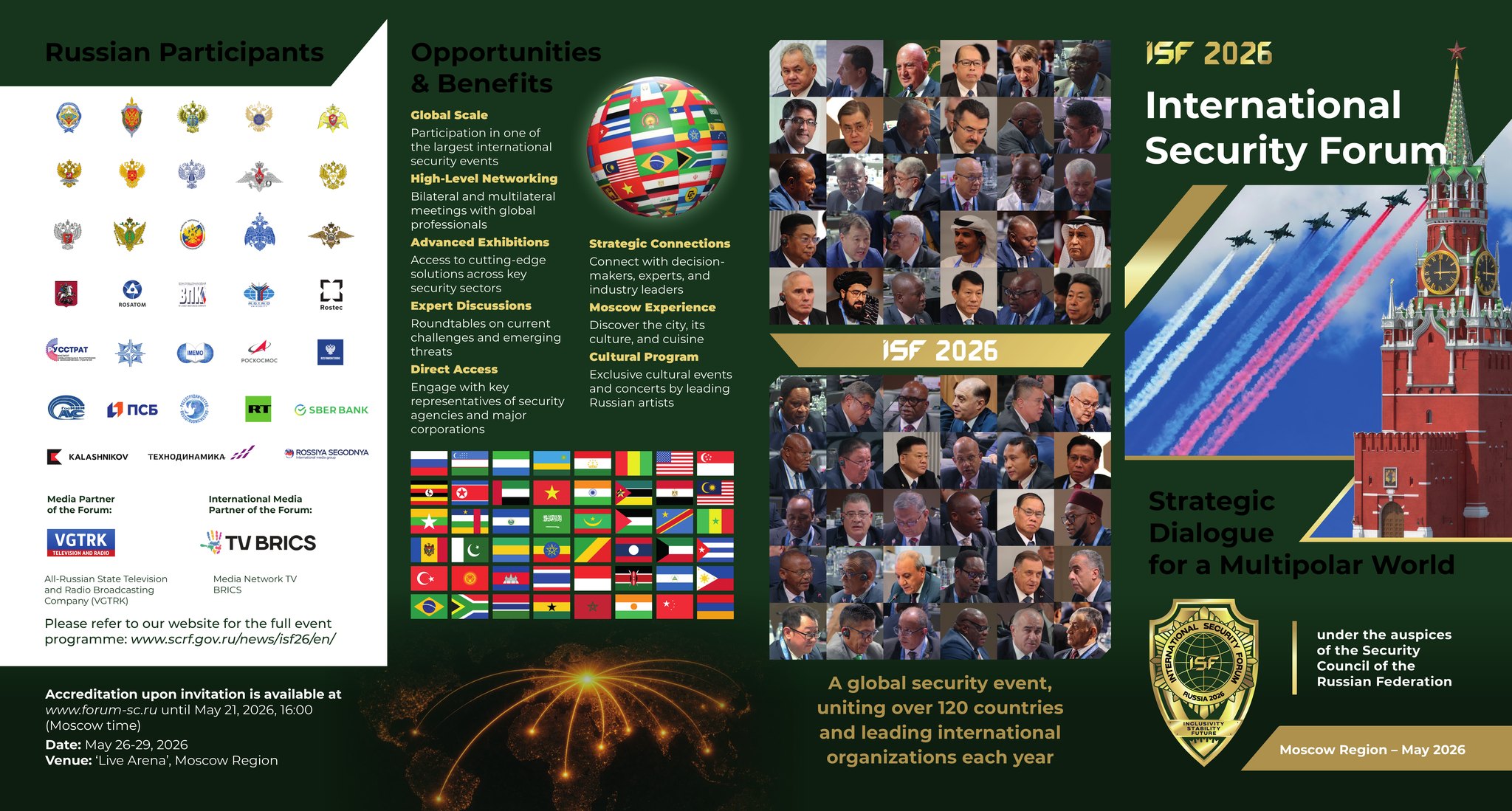

From May 26th to 28th, Russia will organise the first International Security Forum in Moscow gathering foreign delegations and key Russian stakeholders ranging from intelligence services to Rossotrudnichestvo, the cultural agency opening Russian cultural centers abroad. Far from being a new arms sale exhibition, the forum reveals a worldview that not only rejects the Western-led order but casts a wide net of adversaries, from governments to NGOs to the very idea of independent civil society.
In this framing, the West is no longer a partner or even a rival, but a destabilizing force clinging to fading dominance. One conference casts “Disinformation and Manipulation” as tools of “the West’s Hybrid War against the Global Majority.” Another elevates “Countering Neocolonialism” to a security priority for the “Global Majority”—a term that recurs throughout the program and signals a deliberate attempt to build ideological alignment with Africa, Asia and Latin America.
The language marks a sharp inversion of traditional Western narratives. Where Washington and Brussels emphasize democratic resilience and counter-disinformation, Moscow presents itself as the defender of sovereignty against covert Western interference. Nowhere is this clearer than in a session bluntly titled “NGOs as a Tool for Undermining National Security,” which reframes civil society—a pillar of Western foreign policy—as an instrument of subversion.
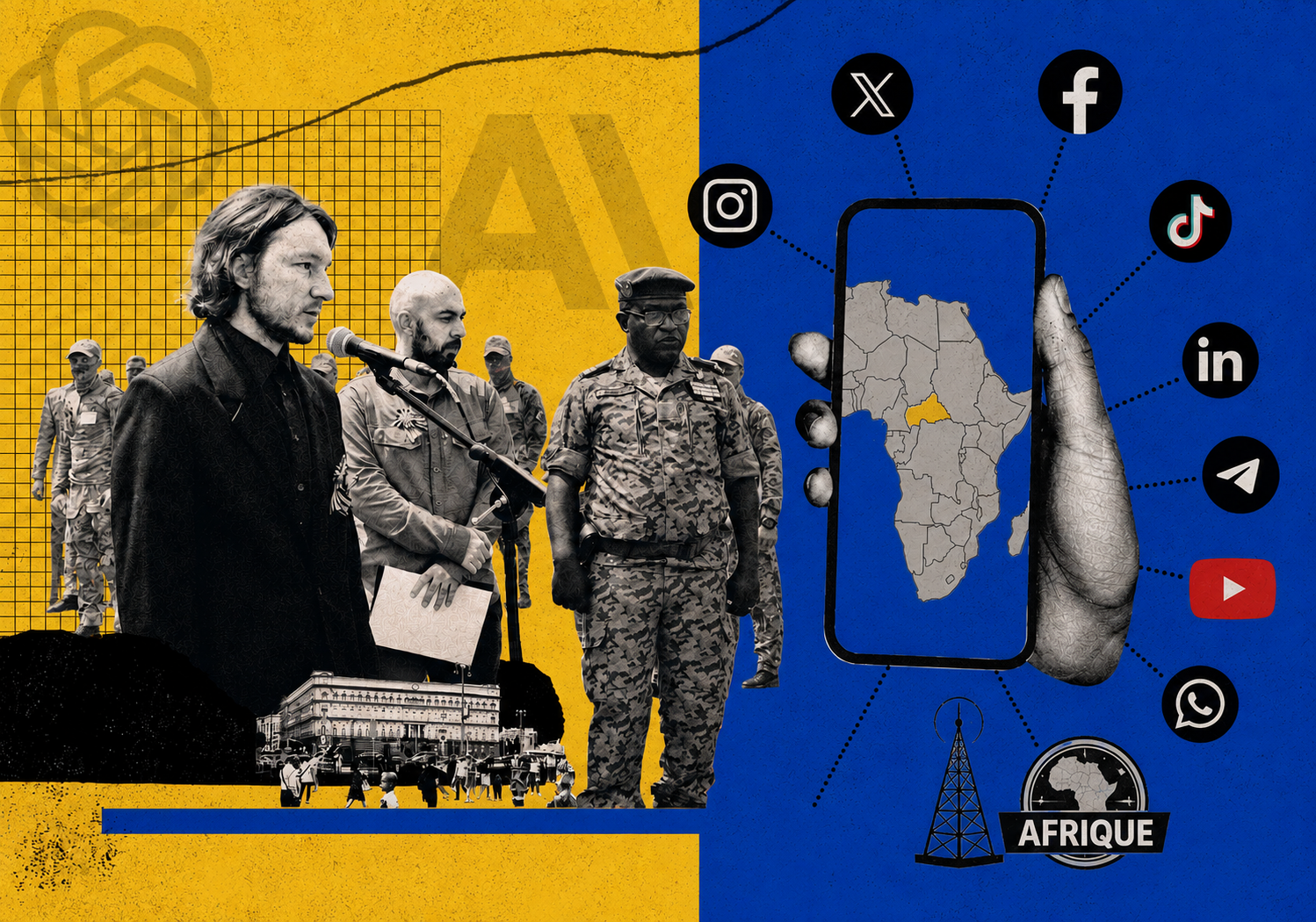
INPACT has been following and documenting how NGO’s are more and more attacked by Russian influence operations and staff from humanitarian organisations have been arrested by the Wagner group in CAR and subject to recurring hostile campaigns.

This is not a marginal theme. It sits alongside discussions of terrorism, hybrid warfare and weapons systems, effectively placing humanitarian organisations, watchdog groups and development actors in the same conceptual category as security threats.
The message to partners in Africa, Asia and beyond is unmistakable: sovereignty requires insulation not just from foreign governments, but from independent actors of any kind. INPACT has investigated in the Sahel and CAR how SVR-controled organisation, Africa Politology, has attempted to lobby for foreign-agent laws in the countries and how the playbook pushed includes the suppression of media and civil society voices.
Ukraine, predictably, occupies a central place in the conferences. Panels on the “terrorist methods of the Kyiv regime” and the “spread of neo-Nazism” are framed as established facts, reinforced by exhibitions and official briefings. The intent appears less about dialogue than about codifying a singular interpretation of the conflict and sharing it with potential international allies.
Equally revealing is the forum’s expansion of “security” into nearly every domain of public life. Discussions of “traditional spiritual and moral values” sit alongside military logistics and unmanned systems, suggesting that cultural divergence itself is being securitized. INPACT has recently documented how the Russian Orthodox Church has become a weaponised vector of influence and how Russian Intelligence Services are targeting the Vatican and non-Orthodox Christians.
Technology, too, is folded into this logic of control. Panels on artificial intelligence, cybersecurity and financial monitoring emphasize surveillance, detection and preemption. The underlying premise is that openness—whether in information flows, financial systems or digital spaces—is inherently exploitable and therefore dangerous. Recent containment of the Russian internet is a prime example of this new security architecture which is slowly put in place in Russia but has also become a solution to be sold for exports.
Finally, the forum sounds more like a political statement and seems to aim at getting endorsed by international visitors. The forum is set to cements an hostile worldview of current international affairs and the West, which is clearly presented as the enemy.

Leave a Reply