
The continent received 1,431 pages of internal documents from “The Company”. Our investigative consortium comprised of Forbidden Stories, Dossier Center, iStories and openDemocracy and a network of Russian-speaking independent journalists identified Africa Politology, the Wagner Group’s influence arm. In the first installment, we reported how the SVR—Russia’s foreign intelligence service—assumed control of Africa Politology. In the second one, we exposed the operators behind the effort, the “cooks in the kitchen,” mapping what appears to be one of the most expansive covert influence campaigns in the Global South designed to advance Moscow’s interests.
In this third episode, INPACT/AEOW uncovers the strategy and tradecraft the Company prepared to secure Russia’s dominance. Far from the anti-colonial rhetoric, multipolar slogans and invocations of national sovereignty Moscow claims to champion, the documents point to a more exclusionary playbook: isolating target countries from alternative partners and systematically undermining competing relationships. It is influence cast as courtship, but practiced as control: a jealous suitor insisting on fidelity, determined to ensure there are no rivals in the room.
Narrowing choices, Isolating to Rule
Recurring images coming from the Sahel of demonstrations with Russian flags and anti-French symbols have made the headlines all over the world. These symbols, highly amplified by Moscow’s propaganda channels, become the new symbols of reclaiming sovereignty.
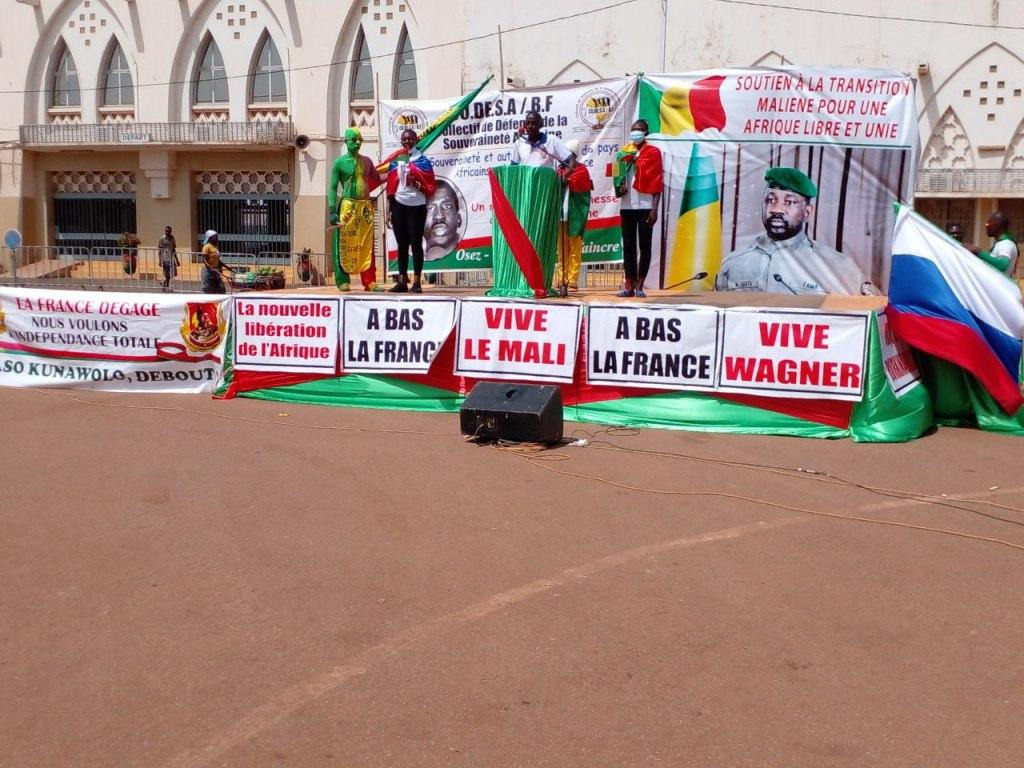
Photo taken by a RIAFANreporter (Prigozhin’s media) demonstation on 5 March 2022 in Ougadougou
2020 has been a turning point for the African continent with a template for coup getting designed in Mali and replicating in countries in the region. Described by some analysts as a movement to complete the cycle of decolonisation, senior Sahel analyst Herve Briand calls it a “momentum of sovereignty” in an article of the Africa Report, arguing that populations will no longer accept “ideas, programs, markets, or even ideological diktats, coming from the West [or elsewhere] imposed on them by force, notably in West Africa and the Sahel in particular.” Yet,as explained by Nathaniel Powell for War on the Rocks, the wave of coups observed in the Sahel and Western Africa stems as well from the perception of local populations “who see their states as corrupt, predatory, and illegitimate”. By supporting these unaccountable political regimes perceived as highly corrupted and failing to solve the spread of regional jihadist insurgencies, Western countries, with France in the first place, are called into question and seen as illegitimate. This has resulted in the rise of anti-French and anti-Western sentiments in the region.
A situation which Russia has largely leveraged with the objective to intensify it, accelerate it and amplify it. Documents obtained over the years by members of the media consortium have shown how Russia has surfed the wave of discontent towards Western countries and old governments in place in the Sahel and Western Africa. They have invested in polls, studies to understand the situation on the ground and crafted offline and online campaigns to exacerbate tensions, as well as relied on intelligence services to gain access to decision-makers and place people in strategic roles.
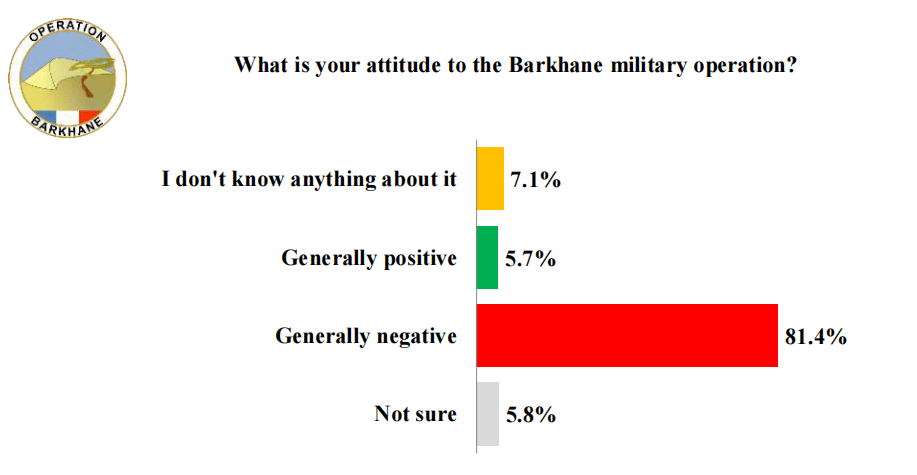
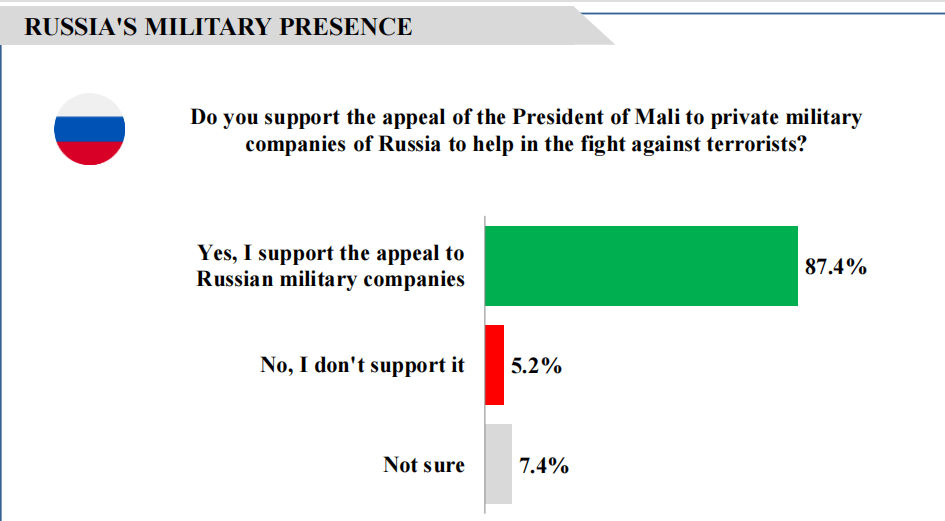
Excerpt from the Foundation for the Protection of National Values (FPNV) survey on Mali dated of September 2021. Now the FPNV is part of Africa Politology and fully integrated by the SVR
But the leaked documents outline insidious tactics used by Africa Politology to establish a long-lasting Russian presence: narrowing leaders’s options, amplifying a sense of siege and presenting Russia as the only reliable partner left standing. According to Clement Renault, researcher at IRSEM and expert on intelligence services, this is the typical blueprint of Russian intelligence services in action: “This seems consistent to me in the way they shape the target’s environment to establish a mechanism of coercion, dependence, and a perception of insecurity (sometimes through kompromats) to encourage cooperation. From this perspective, it doesn’t seem specific to the SVR. It’s a fairly classic tactic used by Russian intelligence services”.
“Keeping Mali in Russia’s sphere of influence”
In Mali, the objective is blunt. The strategy document mentions that the objective to reach is “keep Mali in Russia’s sphere of influence”. The document outlines then the measures which the team needs to take to achieve this goal: “it is necessary to support the current authorities and conduct a complex set of measures for increasing legitimacy and international recognition”. A language which in practice centers on securing a legitimate mandate for Assimi Goïta.
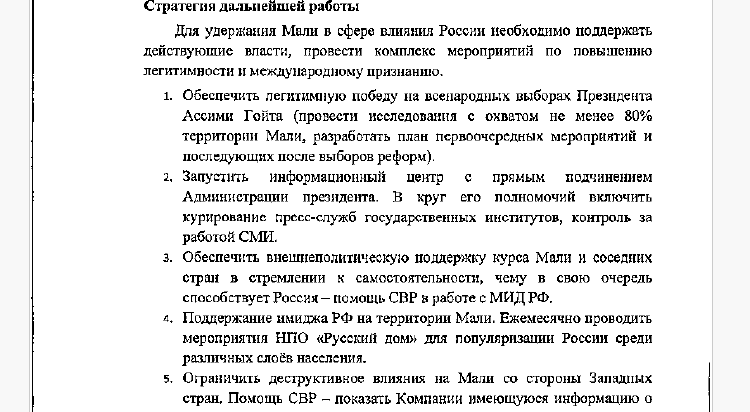
Excerpt from leak titled “Confederation of Independence” allegedly written in August 2023
The plan proposes the organisation of a nationwide research covering most of the country’s territory, the design of priority policy measures and a package of post-election reforms — all aimed at ensuring what it describes as a “legitimate victory.” for Assimi Goita. Parallel to that political track runs a media strategy: the creation of an information center directly subordinated to the presidential administration, with authority over state press services and oversight of the broader media environment.The SVR is mentioned as assisting in coordinating diplomatic backing for Mali’s chosen course, while helping frame Bamako’s posture — and that of its neighbors — as a sovereign push for independence from Western tutelage. At the same time, Moscow would try to disrupt attempts by Western countries – or what they call “destructive influence”- to rebuild ties with Mali by obtaining intelligence about French and US plans for military or political engagement in the Sahel.
The documents also emphasize image management for Russia. The strategy describes monthly programming by the “Russian House” to promote Russia across social strata and to reinforce a partnership narrative. The effect is cumulative: tighten the leadership’s control at home, amplify doubts about Western intentions, and deepen reliance on Moscow for diplomatic and security backing.
But this strategy prepared in August 2023 did not go as planned and there is no information on how Africa Politology adapted to the course of events. Instead the junta took a more authoritarian turn. In September 2023, the elections supposed to take place in February 2024 are postponed without any date announced. In December 2023 the Observatory for the Elections and Good Governance was dissolved. In April 2024, Colonel Abdoulaye Maïga announced the dissolution of political parties following a nation-wide consultation.
Nevertheless, INPACT/AEOW was able to track the work of Africa Politology through the Russian House, which became in 2024 one of the centre of gravity for discreet political influence. Opened in June 2022, the Russian House belongs to the non-state network not officially linked to Rossotrudnichestvo (but directly managed by Africa Politology). Not only its programming “across all social strata” has been intensive but also relying on a well connected director, Aliou Tounkara – a member of the Malian National Transition Council -, has turned the cultural centre into a place for public affairs. Tounkara has been a key person with whom Russia has been engaging: featured on Russia Today or Sputnik. He has also been invited as a guest of honour to the Russia Africa summit sumit in 2023.
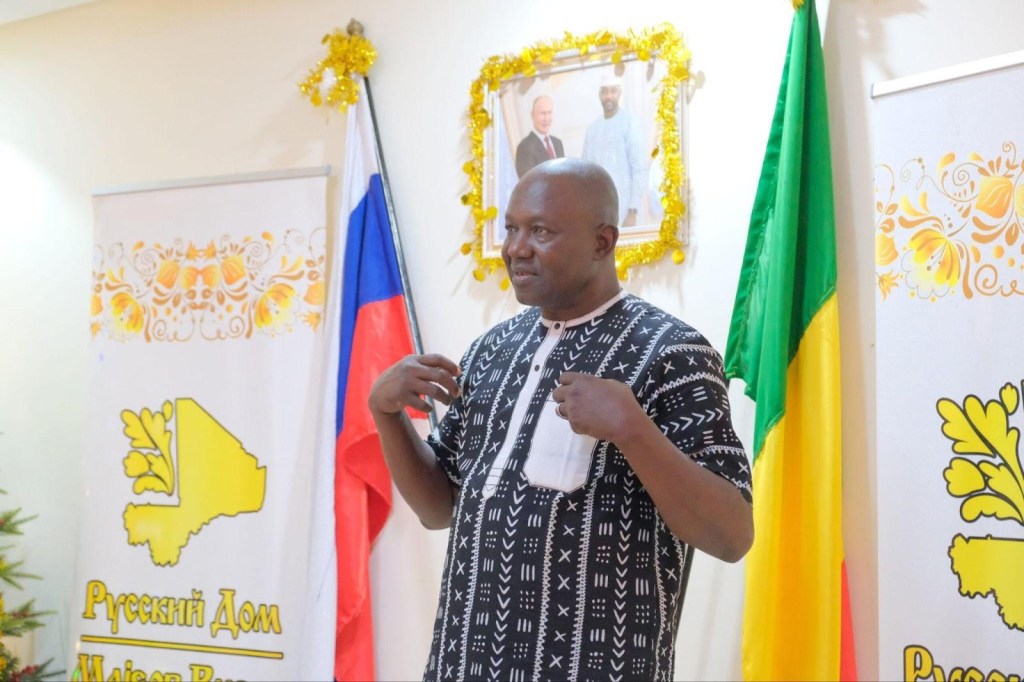
Photo of the franchised Russian House in Mali (source Telegram)
His statements are often re-used by Russian official bodies.
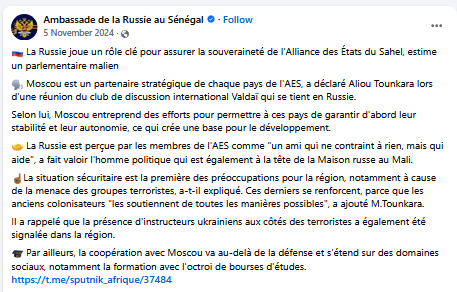
Facebook account of the Russian Embassy in Senegal
Tounkara is the key entry point to the Malian diaspora in Russia as he is the president of the Council of Malians in the Russian Federation. This is important not only because the Russian House in Mali is establishing partnerships with universities for student exchanges but also because 38 Malians have enrolled in the Russian army since 2024 to serve on the battleground in Ukraine.

Photo of Tounkara at an event sponsored by Russia, and Russian influence projects “African Initiative” and “Perspective Sahelienne” visible in the background
This enables other individuals and organisations to gravitate around him and the Russian House. According to sources and research, representatives of the Malian government like Oumar Diallo, the Prime Minister Chief of Staff, or Mariam Diarra Savané, Deputy Head of Parliament’s International Affairs Committee, are attending events at the Russian House. But also, Russian organisations closely related to the Russian security services like African Initiative and its spin-off the Perspective Sahelienne, headed by Malian blogger Mahmadou Bah, are present.
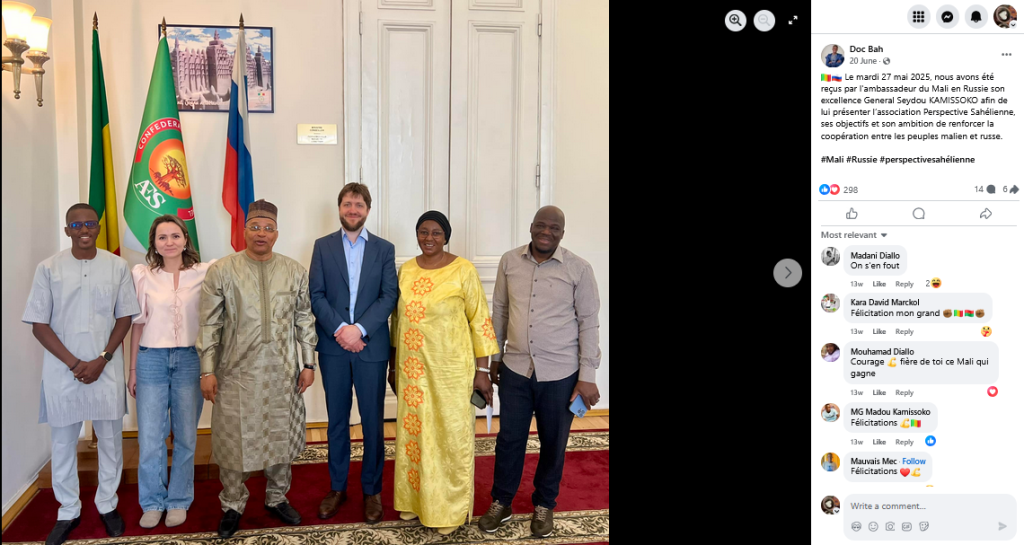
Members of the Perspective Sahelienne at the Russian Embassy in Bamako
Finally the Russian House in Mali is also working with local activist groups aligned with Moscow’s views like Le Groupe des Patriotes du Mali (the Malian Patriotic Group) which is very straightforward about its allegiance and positioning.
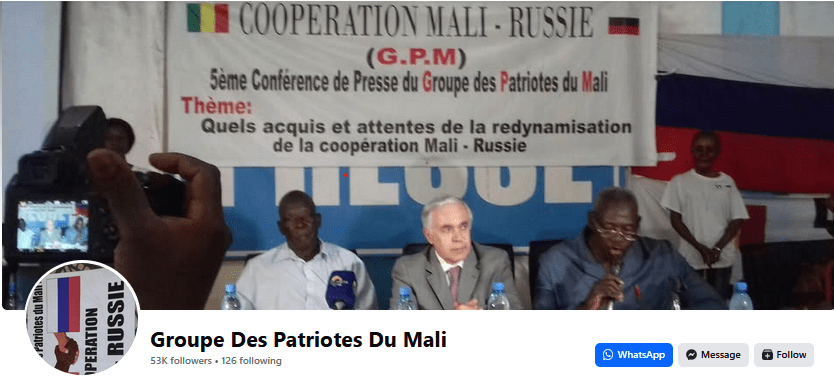
Facebook account
Amplifying Western Pressures in Niger and Chad
In Chad and Niger, the playbook shifts but the logic holds.
For Chad’s leader, Mahamat Idriss Déby, the documents propose creating conditions — through media activity, diplomatic engagement and work with Western public organizations — that would increase Western pressure on his government. The goal is counterintuitive: not to shield him from criticism, but to intensify it, nudging him to seek alternative partnerships when relations with Washington or Paris fray. The strategy is very clear “Deby must understand that the Russian Federation is his friend”
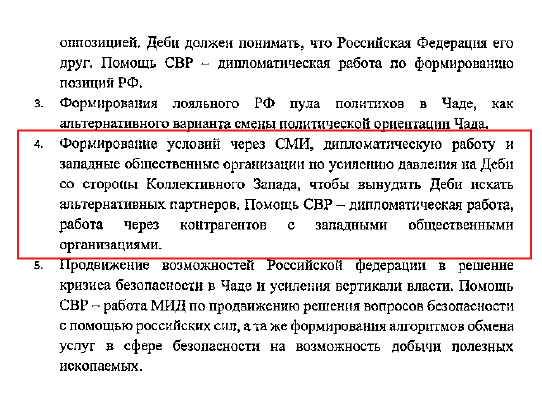
Excerpt from leak titled “Confederation of Independence” allegedly written in August 2023
Traces of this strategy appear in leaked documents our consortium obtained listing articles Africa Politology allegedly paid. For Chad, Africa Politology sponsored 171 articles over a year amounting to 96,750 USD. The articles are a mix of praises to the Chad-Russia partnership, Chad interacting with the BRICS and articles mentioning deteriorating relations with the US and France. Some embarrassing affairs are amplified in the Chadian ecosystem while others are completely made up and serve discrediting Western partners. A journalist whose articles were included in the media budget stated he was not compensated for them.
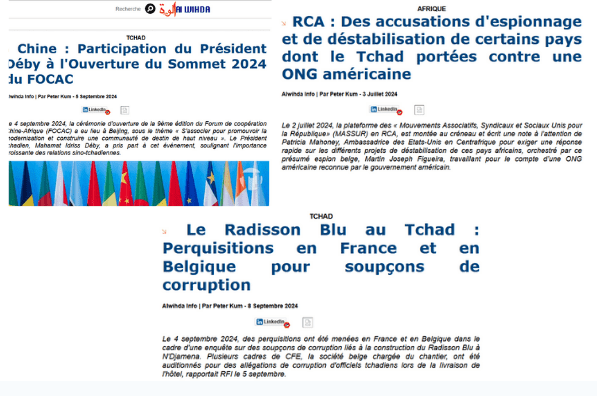
Some articles reporting on the tensions between Chad and Western countries, embarrassing stories and a made-up espionage campaign against the USA
In Niger, where General Abdourahamane Tchiani seized power in 2023, the strategy is even more explicit. The objective is to block any meaningful dialogue between the new authorities and Western capitals and ensure that external pressure in the media- highlighting tensions with the West and how the West is pressuring the junta – keeps the junta anchored in partnership with Russia rather than drifting back toward Europe or the U.S.
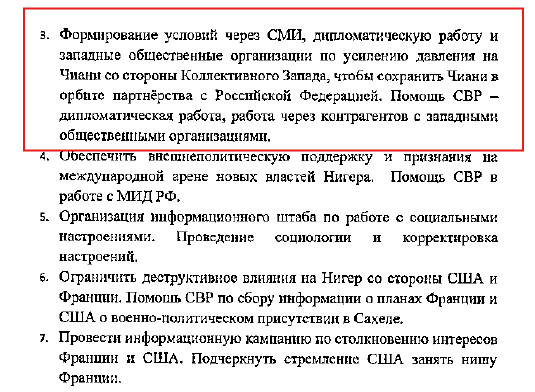
Excerpt from leak titled “Confederation of Independence” allegedly written in August 2023
The strategic objective is to turn Russia into an indispensable partner through a balanced calibration: enough isolation to deter any Western rapprochement, but not so much instability that the regime collapses. Moscow appears in the end as the power offsetting sanctions, offering security assistance and providing diplomatic cover.
Making Rajoelina “maximally inconvenient and unacceptable” to the West
The approach to Madagascar is even blunter and insidious. At the time the strategy was prepared, the island nation maintained diplomatic neutrality over the war in Ukraine in United Nations votes. But Africa Politology’s internal assessments warn that President Andry Rajoelina began to distance himself from Moscow, caused by what is described as a passive approach from Russia’s Foreign Ministry.
Russia’s interest in Madagascar has been long-lasting and the Wagner Group was very active a few years before with interference in the 2018 election and the obtention of mining permits.
To pull Mr. Rajoelina back into its orbit, the proposed strategy is stark. Make him “maximally inconvenient and unacceptable” to the West by linking him publicly to Russia. The information operation strategy contemplates accusations of corrupt ties with Moscow, with the expectation that Western governments might respond with secondary sanctions against him. Africa Politology believed at the time Rajoelina would have no choice but to turn to Russia. In addition, the Company recommended replacing the Ambassador at the time with a SVR officer more acquainted with the art of influence and recruitment than a career diplomat. He would have to persuade the president that his political survival depended on Moscow’s backing.
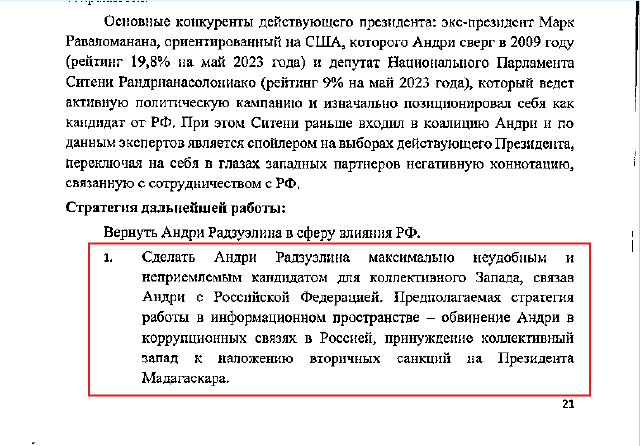
Excerpt from leak titled “Confederation of Independence” allegedly written in August 2023
This plan did fail and Rajoelina was never listed on international sanctions. But again INPACT could trace through articles and media coverage the attempt to spin a narrative of corruption and links with Russia. Current conditions have changed and the new leader of the country seems more approachable for Russia.
Similar other cases are spotted in the documents. Africa Politology does not only promote a good image of Russia but it undermines target countries’ reputation and image to narrow choices and appear as the solutions of problems. In Equatorial Guinea, the strategy calls for fostering “a climate of increasing insecurity,” pointing to internal power struggles, regional tensions and even the circulation of claims about alleged U.S. plans to unseat the country’s leadership. The objective is not necessarily to invent crises from scratch, but to magnify existing fractures so it becomes the dominant belief. Russia can then come and offer the unique solution left: a Russian partnership and security solution.
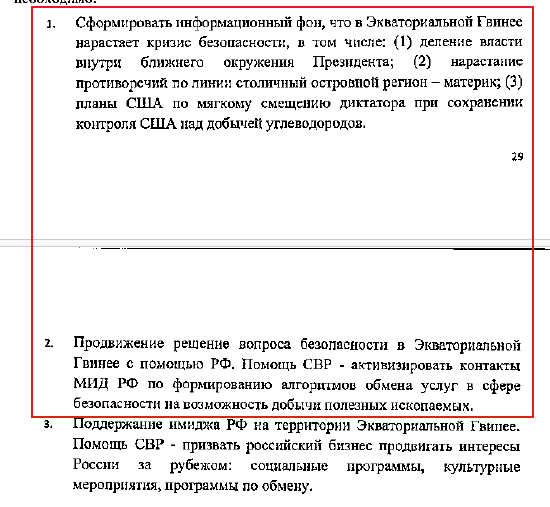
Excerpt from leak titled “Confederation of Independence” allegedly written in August 2023
If doors to Washington, Paris or Brussels close, African leaders may find that only one remains open. In that situation, partnerships are not anymore about sovereignty but a choice by default.
A No-Rival-in-the-Room strategy
Isolation is not the only tactic used by Africa Politology. INPACT/AEOW has understood that the Russian influence strategy relies on a triptych: promoting a positive image of Russia, isolating target countries and dismissing any competition. Pushing Moscow’s interests in so called Global South countries means also discrediting historical Western competitors like the West, the USA and NATO. Well-known campaigns have mainly targeted France on the African continent. These campaigns are known to be relentless while not always well crafted or impactful. The goal is to keep them coming weeks after weeks. The wildest campaign ever put together remains the Gossi mass grave fake targeting the French army. Since then, France has been targeted every single week. The US has also been heavily targeted in 2024 as they tried to renew relations with some key countries or negotiate their stay like in Niger. Africa Politology crafted a strong anti-US strategy in the Central African Republic for example on which INPACT/AEOW will come back in a later episode.The objectives are clear: countering US presence in CAR, especially Bancroft PMC and American NGOs. Several actions are organised to deter the US from the country. INPACT assesses these actions as successful.
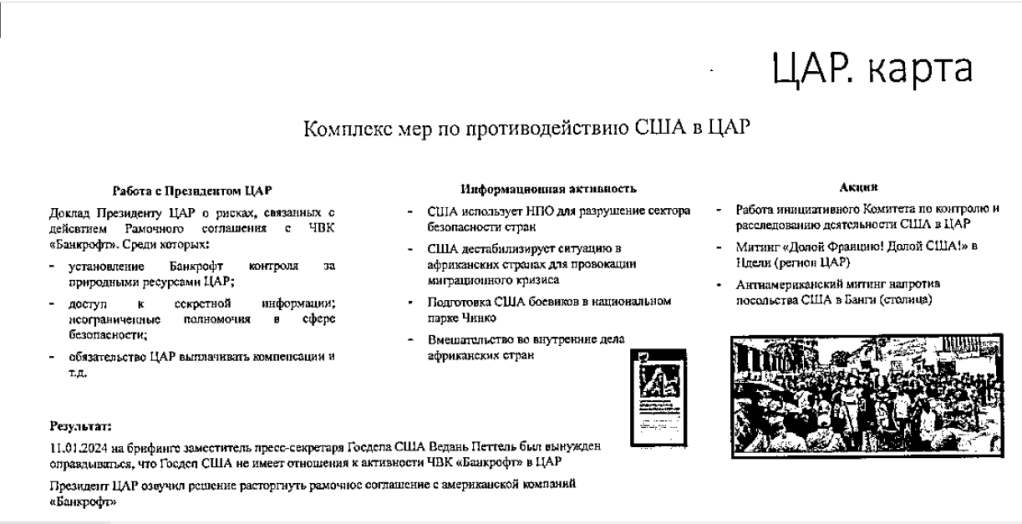
Excerpt from the CAR Strategy titled “Set of measures to counter the US in CAR”
But Africa Politology is also targeting other countries perceived as competition, like Turkey. The no-rival doctrine is very visible in the campaign to blunt the ambitions of Turkey and through them the US and NATO. Politologists have mentioned Turkey as a competitor in 20 documents with very detailed actions to raise the cost for the country. Sales of drones are mentioned for Chad and Sudan. But nowhere do Russian and Turkish interests collide more directly than in Libya. The objective for Russia is simple: turn Libya into a bargaining chip with Turkey to negotiate political and military points like votes at the UN or air space use for flights.

Excerpt from the Company’s Africa Strategy document
The internal leaked documents show multiple assessments done on the position of Turkey in Libya. In one document the team assessed that Ankara military intervention to back the Tripoli-based government was decisive and forced the Libyan National Army to retreat from the capital and reshaped the balance of power.The documents reveal a steady production of memos on Turkish moves: the visit of Turkey’s intelligence chief to Libya; negotiations between Ankara and Cairo; analysis of Turkey’s “Mavi Vatan” maritime doctrine; and assessments of Turkish policy in Africa more broadly.
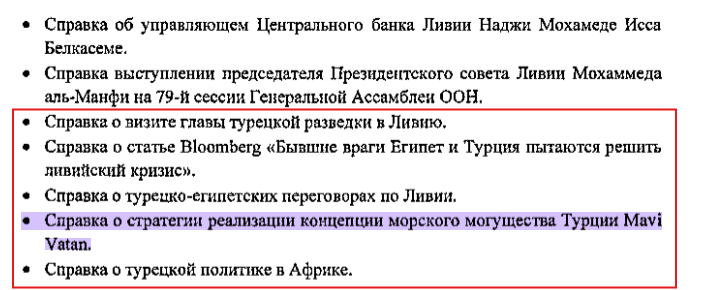
List of memo budgeted on Turkey in a leaked financial document
The response strategy is based on two work streams: contest Turkey on the ground while undermining it in the information space.
Operationally, Russian contractors are portrayed as having stabilized the front lines, helped organize air defenses capable of countering Turkish-made Bayraktar drones and preserved a territorial divide that limits Ankara’s reach beyond western Libya. The Company reports Wagner contractors have sent back to Moscow samples of Bayraktar for studies.
But the more intricate campaign unfolds in media briefs and “informational cases.” Among the proposals: “cultivate anti-Turkish sentiment among Libyan elites and the broader population”; “block Ankara’s military-political projects”; and, crucially, “form contradictions between NATO countries on the Libyan track (Turkey versus the USA).”
One strategy explicitly envisions amplifying tensions between Washington and Ankara over overlapping interests in Libya, including through articles featuring Turkish commentators critical of U.S. ambitions in Africa. A modest budget line — $10,000 for “organizational work” — is earmarked to deepen such contradictions on the Libyan file.
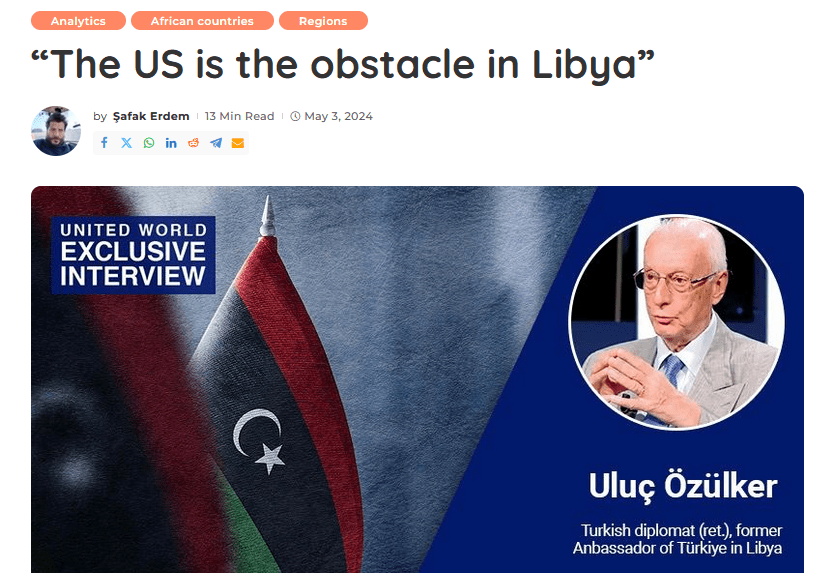
Example of a commentator used for the campaign
The website linked to the historical Prigozhin galaxy which keeps reappearing to support Africa Politology’s campaign is United World International. Located in Istanbul, the structure is controlled by the Gorev Foundation, a small foundation linked to Görev Vakfı, an industrial group with political ambitions and a pro-Russian positioning. UWI was placed under sanctions as its editor in chief was Darya Dugina at the time she was working for Evgeny Prigozhin. The website recycles campaigns aiming at stirring a rift between NATO members, especially Europe and Turkey or The US and Turkey, giving the impression that the information emanates from Turkish sources. The idea is to complicate Ankara’s alignment within NATO.
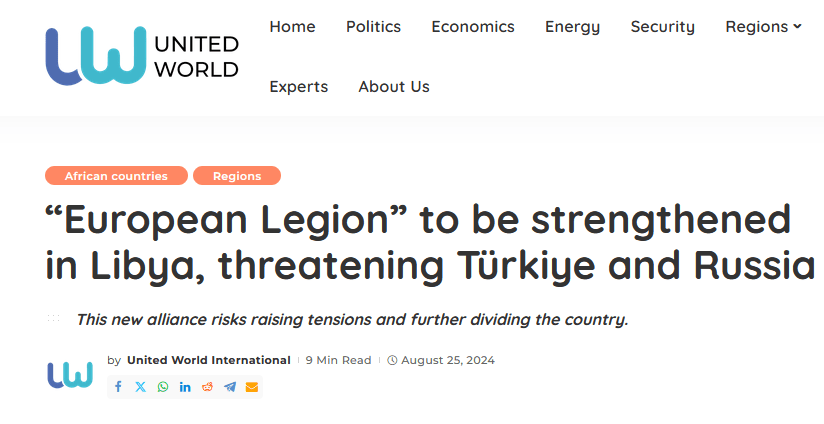
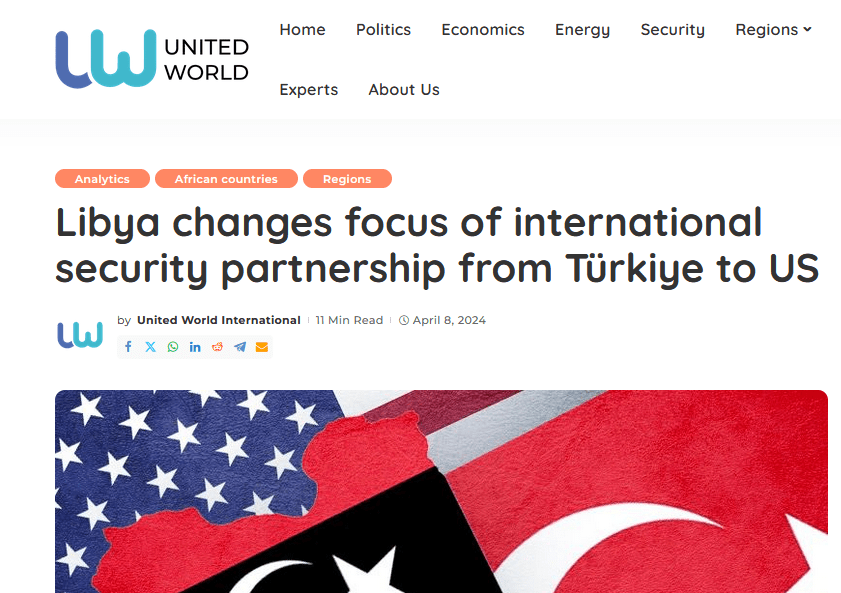
Parallel media placements in African outlets depict Turkey as a proxy for other Western powers, especially Germany — or as a destabilizing actor pursuing narrow economic gain.
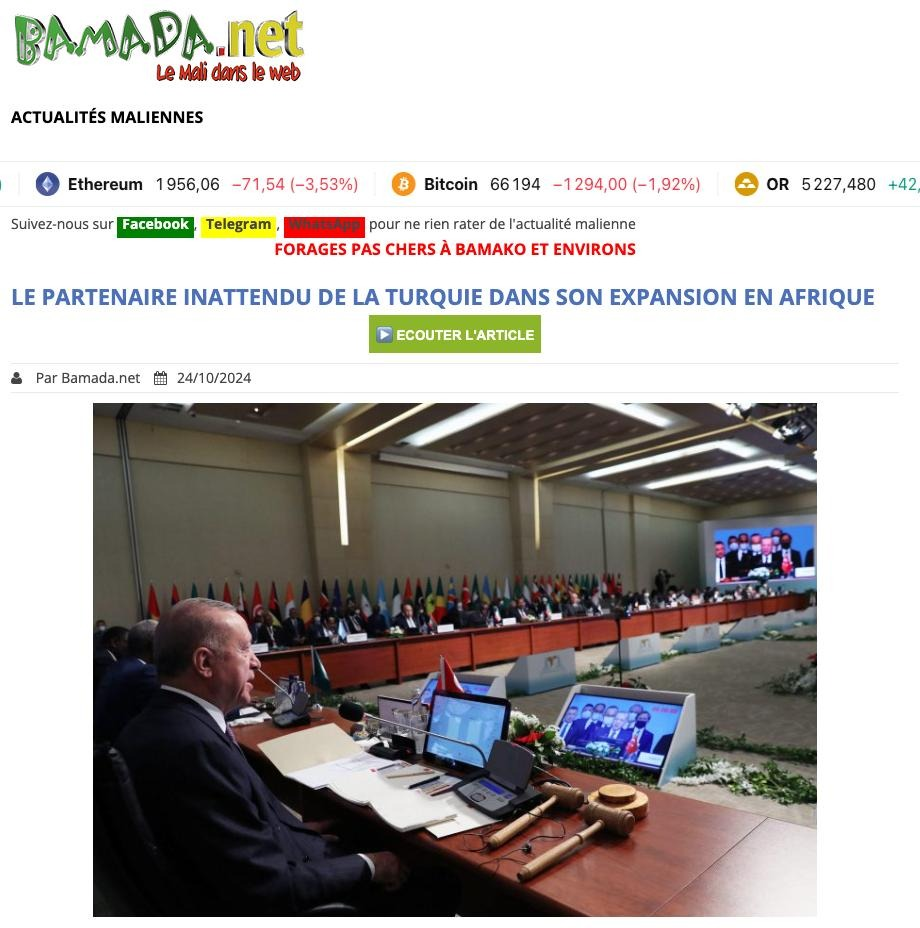
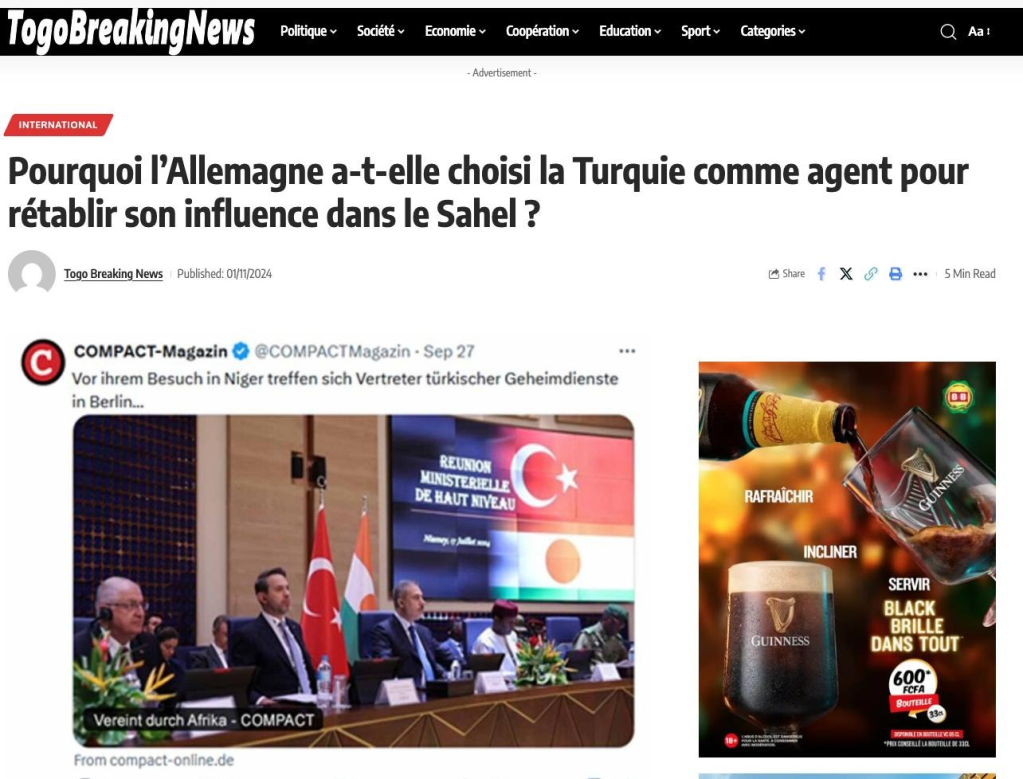
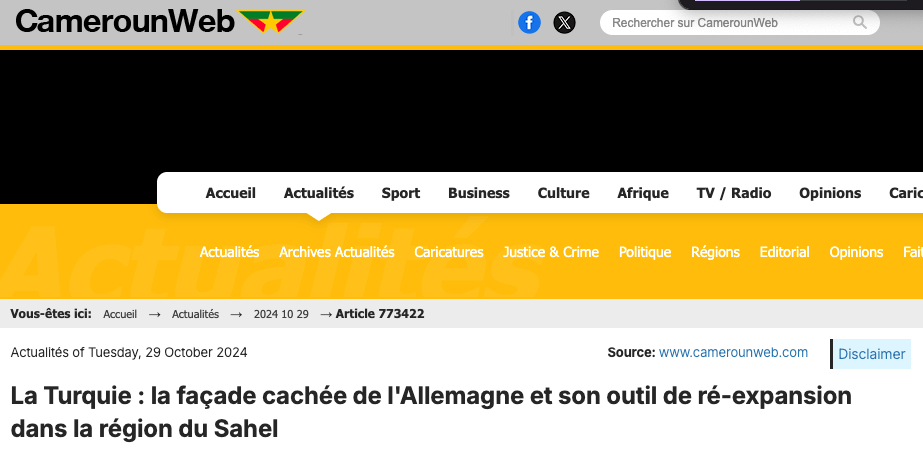
Articles allegedly paid by Africa Politology
Other articles question Turkish drone supplies to Tripoli groups to suppress protests, highlight alleged involvement in smuggling networks and amplify friction between Turkish-backed authorities and rival Libyan factions.
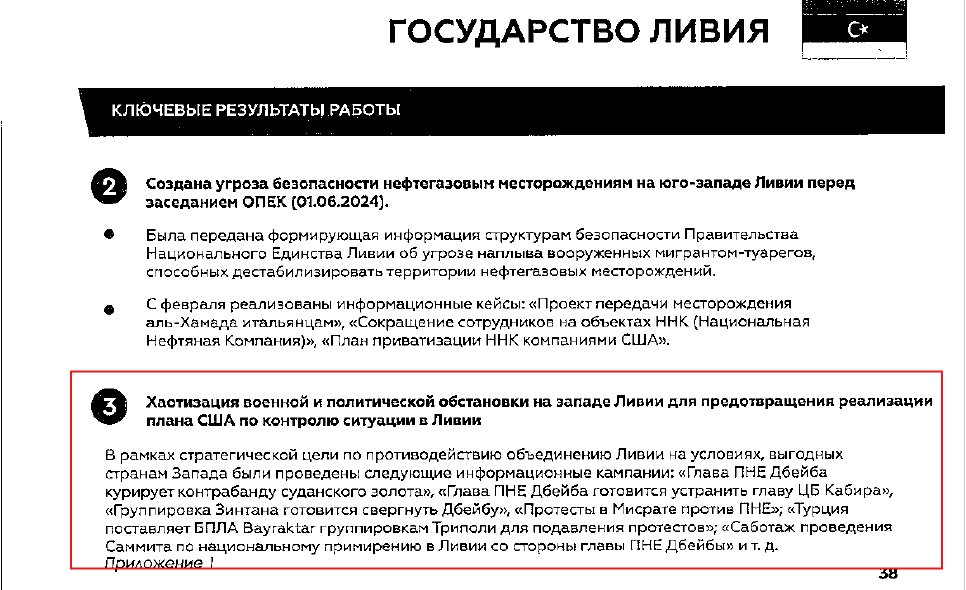
Excerpt of the “Global South Strategy” – part on Libya: “Chaotisation of the military and political situation in Western Libya to prevent the implementation of the US plan to control the situation in Libya”.
The goal of all these campaigns is not to expel Turkey outright. It is to ensure that Ankara’s position remains contested, costly and diplomatically fraught. The pattern is consistent: portray Turkey as overextended, opportunistic and vulnerable to shifts in Washington’s policy.
A strategic one-page memo dated October 2024 looks further ahead. It calls for intensified collection of insider information on Turkey’s activities in Libya and Africa, with particular attention to the internal balance of power in Ankara.
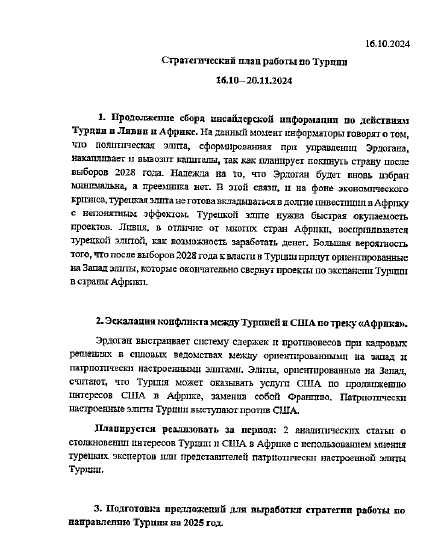
Strategic 1-page memo dated of October 2024 and titled “Strategic Workplan on Turkey”
According to the assessment, President Recep Tayyip Erdoğan presides over a divided elite — some oriented toward the West, others more nationalist in outlook. The papers speculate that Erdoğan’s political future beyond 2028 is uncertain and that a Western-leaning successor could curtail Turkey’s African expansion. The plan proposes escalating friction between Turkey and the U.S. along the “Africa track,” including through analytical articles citing Turkish experts who argue that Ankara should resist serving American interests on the continent. If Western-oriented elites in Ankara believe Turkey can replace France as Washington’s preferred partner in Africa, the counter-narrative would seek to deepen mistrust between the two allies. Libya, again, is at the heart of this strategy. The country is viewed by Turkish elites as one of the few African ventures offering quick economic returns. By keeping Libya unstable, politically fragmented and diplomatically sensitive, Moscow can raise the costs of Turkish engagement while preserving its own leverage. Africa Politology offers a bargaining chip to Russian diplomats for negotiations.
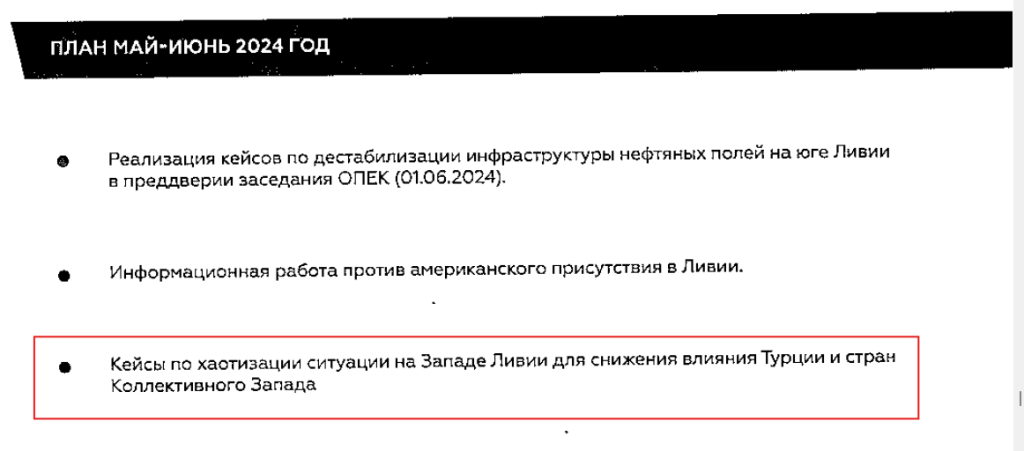
Excerpt of the “Global South Strategy” – part on Libya: “Cases of chaotic situations in Western Libya to weaken the influence of Turkey and Western countries”.
If a rival cannot be expelled, at least make his work harder: Russia does not need to dominate every arena outright. It needs to ensure that competitors like Turkey cannot operate uncontested.
However Turkey has kept gaining a discreet footprint on the African continent. Turkey starts to be everywhere on the continent with weapons showcase in Bamako or trainings organised by Canik Academy to some Malian forces. In April 2024, Burkina Faso received a dozen of drones like Niger. According to Jalel Harchaoui, specialist of Libya with London’s Royal United Services Institute, “One ought to note that Turkey has consistently coordinated with Russia since Haftar’s forces collapsed on the outskirts of Tripoli in May 2020, yet this alignment should not be taken for granted. Just as Russia pursues its own national interests in Libya, Turkey, too, may seek to expand its territorial sphere of influence in the country. The demarcation line between the two powers has remained largely static for nearly six years, but early signs and clues suggest a growing appetite in Ankara to push further South. This is particularly plausible given that, after a full year of intensive Turkish diplomatic courtship of the Haftar family, Benghazi has yet to ratify the 2019 maritime border memorandum. With multiple options at its disposal, Ankara may well decide to act at the expense of the Russian presence in southern Libya.”
In the end, the leaked documents also reveal the limits of the exclusivity and no-rival approach. Elections slip beyond control. Sanctions fail to materialise. Turkey adapts. Local actors maneuver. Sovereignty, once awakened as a political force, does not always align predictably with external designs. Even regimes that lean toward Moscow retain agency — and alternatives. Russia’s no-rivals doctrine rests on a fragile hypothesis: that isolation can be carefully calibrated without triggering backlash, collapse or strategic overreach. It assumes that leaders, once cornered, will choose loyalty over diversification. But dependency built on narrowed choices is inherently unstable.
In the end, “Love Me Alone” is a strategy. A strategy that seeks to turn geopolitical competition into exclusivity. Whether it succeeds will depend less on Moscow’s capacity to sow doubt than on whether African leaders — and rival powers — accept a world in which partnership means the absence of alternatives.
 Investigations with Impact
Leave a comment