
Singular Stories
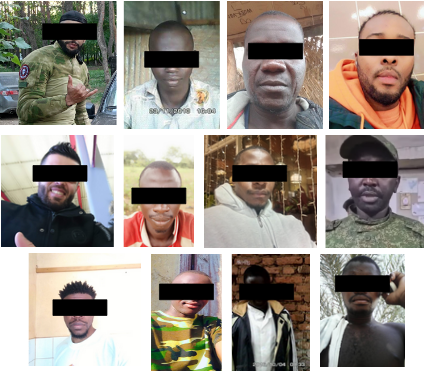
Their names are Serge, Nabil, Samuel, and Eric, and they come from different countries on the African continent. What they have in common is they fight as foreign soldiers in the Russian army. They tell us their journeys all started the same way: mysterious travel agencies, extensively advertised on social media, offering heavily discounted airline tickets to Russia. The role of these agencies is to connect young men with the Russian army.
We speak to Ahmed [name changed to protect his identity], a young man under thirty, originally from a North African country, serving in the Russian army. The exchange is not easy, and Ahmed makes no secret of his hostility toward European countries. Haunted by the death of a relative – whom he claims was killed by the French – he displays a thirst for revenge and is not shy about making threats. According to him, European countries, like France, are next on Russia’s list. He tells us several times that he will come for us.
He likens the Russian Army to an international football team, made up of the best players from diverse backgrounds who have taken the nationality of the country they now represent. He tells us that his second nationality is now Russian, that he has obtained a passport, and that he is proud to serve alongside the Russians. Ahmed indicates that he is not alone in this situation, and that many foreigners have made this choice.
Serge, Nabil, Samuel, Eric and Ahmed were among almost 1,500 names provided to INPACT on a database of African recruits to the Russian Army. Drawing on this list, INPACT set out to investigate the individuals who have made this journey, seeking to understand their motivations and experience, and the recruitment process which took them from Africa to the frontlines in Ukraine.
Executive summary
Since 2023, the Russian Federation has intensified its efforts to address the shortage of personnel in the Russian armed forces, as it seeks to manage the grinding war of attrition in Ukraine and the strengthening of international sanctions targeting its economic capabilities, the Russian military-industrial sector, and the activities of its paramilitary networks abroad.
Faced with these constraints, the Kremlin has launched a structured recruitment campaign, targeting historic allies and the Global South, with a particular focus on the African continent. This campaign aims to recruit and deploy African nationals to the Ukrainian theatre, leveraging transnational networks that exploit persistent socio-economic vulnerabilities. INPACT has identified recruitment tactics that target young people aspiring to pursue higher education abroad, particularly in fields presented as strategic; job seekers eager for economic opportunities; and candidates for irregular migration to Europe, for whom Russia is presented as an alternative route.
Working with contacts and the “Khachu Zhit/I want to live” project, INPACT obtained several files containing lists of recruits from Africa, including one more comprehensive file with two tabs:
- A list of 1,417 nationals from African countries with their full name, date of birth, military registration number, the date they signed their military contract in Russia, and their citizenship.
- A second list detailing those killed in action. It includes the name, date of birth, military service number, contract signing date, recorded date of death, number of months enlisted before death, citizenship, and unit of affiliation within the Russian army.
INPACT set about verifying this file by investigating the digital traces, including social media postings, left by the purported recruits. INPACT was able to identify a sufficient number of individuals who had posted about their time in Russia and military involvement to conclude that the list was legitimate. A few errors were identified regarding the nationalities of some individuals, which can likely be attributed to incomplete data entry. Further research also identified combat deaths not mentioned on the list, indicating that the list was not exhaustive and the number of African nationals recruited is likely to be higher.
Based on these list and subsequent research, INPACT has concluded that the recruitment of African nationals is not an isolated phenomenon, but rather the core of a deliberate and organised strategy. These recruits have been integrated into assault waves designed to overwhelm Ukrainian defensive lines, contributing to a strategy of attrition. From the recruits’ perspective, recruitment is driven by a desire for social and geographic mobility, within a context marked by structural poverty, political instability, and recurring crises on the African continent. This asymmetrical convergence of interests constitutes the core target of the recruitment campaigns observed.
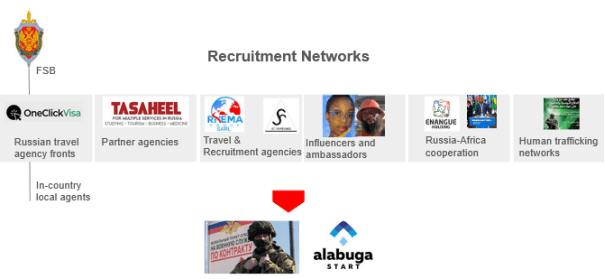
INPACT identified several complementary recruitment tactics, including the use of travel agencies operating as logistical intermediaries, the involvement of local pro-Russian individuals and organisations, and recruitment networks based on co-optation, in which former recruits become recruiters themselves. These schemes rely heavily on bogus job offers, promises of education or administrative regularisation, and irregular immigration channels.
INPACT also identified an example where the involvement of Russian security services was explicitly mentioned – the Federal Security Service (FSB), which is believed to coordinate all or part of these recruitment networks. A significant portion of recruitment activities take place online, primarily on social media, which today constitutes one of the main channels for information and migration planning for young Africans.
Download our report and the list of African KIA INPACT received: here


 Investigations with Impact
Leave a comment