

Since the war in Ukraine, China has increased its support for Russia with official declarations of support, an alignment of narratives, and the establishment of a continuous line of access to financial capital and military equipment. But this exchange is not one-sided, and cyber data leaks posted online by the cyber activist group Black Moon reveal the significant role of the Russian research and industrial complex in supplying equipment to China, particularly in equipping the country with highly specialized capabilities for airborne operations. INPACT reveals the strategic role of another company, Poly Technologies Inc., an arms company which is very active on the African continent, in the acquisition of these sensitive technologies.
Poly Technologies Inc: The PLA buys technology transfer from Russia
This is the company no one has heard of. It’s discreet, yet it operates in all areas of activity, with offices in Asia, Australia, the USA, and the UK, and operations throughout Africa. The arms company Poly Technologies Inc. (保利科技有限公司) was created in 1984 by the People’s Liberation Army to export weapons abroad and create a competitor to NORINCO. It was built thanks to very close family ties between its initial leaders and members of the Chinese Communist Party and the Chinese military. Initially, Poly Technologies exported PLA surplus weapons abroad, and its revenues were reused to subsidize the military’s development. Since then, Poly Technologies has built an empire of more than 2,600 subsidiaries. The group, now China Poly Group, is under the control of the State-owned Assets Supervision and Administration Commission of China and the Chinese Military Commission, and its activities range from real estate to arms sales and art sales. Poly Technologies’ weapons culture remains present, however, with members of Poly Technologies on the board of directors of Poly Culture Group, the cultural arm of more than 150 subsidiaries, of China Poly Group, when it was listed on the stock exchange.

The defense company is particularly active in Central Asia, the Middle East, and especially in Africa. As the commercial arm of the PLA, Poly Technologies has supplied several authoritarian regimes with military and law enforcement equipment, such as in Zimbabwe, and has transported weapons to conflict zones such as Sudan.


Poly Technologies also provides critical support to Russia in Ukraine, supplying gunpowder and equipment to the Russian military. Furthermore, Poly Technologies has been under the radar of international sanctions authorities since 2013 for supplying equipment to proliferation-risk countries such as North Korea, Syria, and Iran. This suggests the direct involvement of the Chinese People’s Army, which, under the guise of declared political neutrality, participates in armed conflicts by supporting them and the development of proliferation programs in violation of international treaties.
Poly Technologies has made $234 million in purchases in Russia since 2019
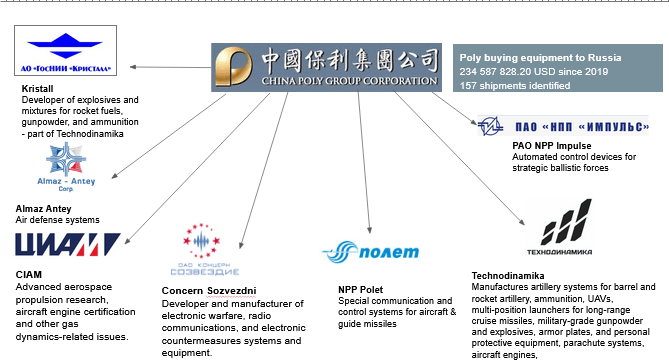
But Poly Technologies Inc. doesn’t just sell weapons and has established a buyer relationship with Rosoboronexport. INPACT has located a total of 157 shipments from several Russian laboratories and companies affiliated with the military-industrial complex since 2019, for a total amount of USD 234,587,828.20.
Very interesting companies are also included in Poly Technologies’ list of partners: Technodinamika, Concern Sozvezdni, PAO NPP Impulse, and NPP Polet. They are part of a Russian project called “Project Sword” to build some new Chinese capabilities.
The importance of the “Sword” Project for the future of Taiwan
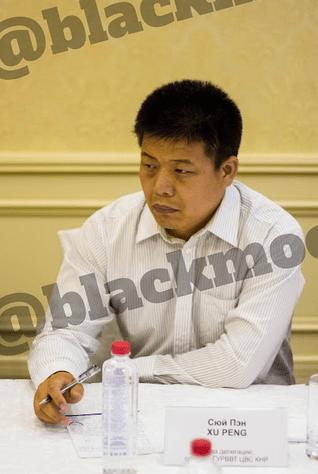
Last July, a self-proclaimed hacking group, Black Moon, published in installments selected documents likely from a data leak that INPACT was able to consult. These documents demonstrate a new type of agreement between Russia and China and highlight a genuine technology transfer involving a large number of Russian companies and scientific centers coordinated by Rosoboronexport and Chinese companies such as CETC International and Norinco. By providing expertise and specific equipment for airborne operations, China is suspected by military experts of preparing for an invasion of Taiwan.

The articles published respectively by The Insider and the Royal United Services Institute (RUSI) provide additional information on the growing military cooperation between Russia and China, and more specifically on the technological transfers likely to support an operation to seize Taiwan. The Insider’s investigation draws on internal documents and customs data revealing the supply by Russia to China of an automated command and control system for airborne troops, as well as the delivery of technical documentation, digital media, and the training of Chinese personnel. These elements confirm the existence of a structured transfer of Russian know-how in airborne operations and tactical management.

RUSI complements this reading by highlighting the strategic significance of the partnership: Russia is reportedly providing not only equipment—including parachute systems and airborne vehicles—but also doctrinal expertise enabling the People’s Liberation Army (PLA) to fill its gaps in the field of rapid insertion operations.
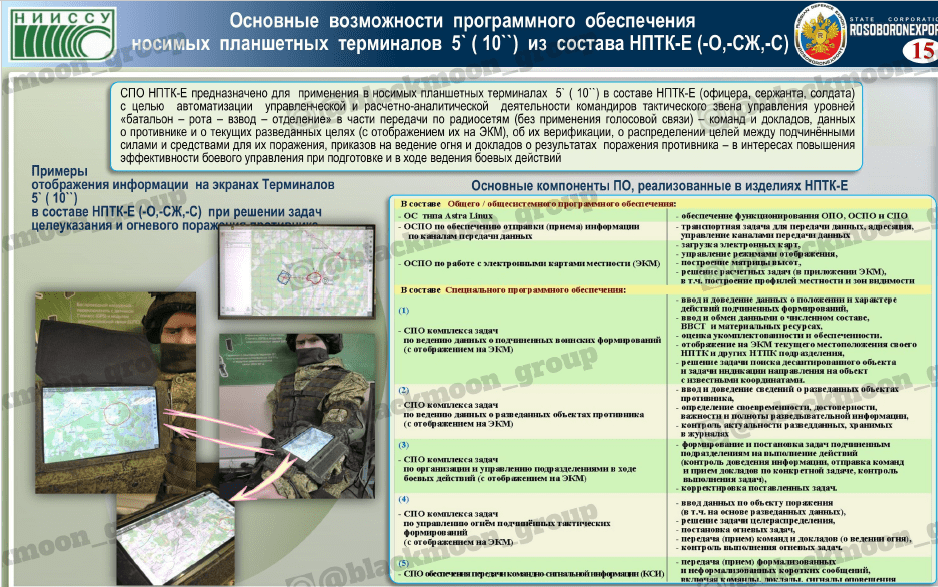
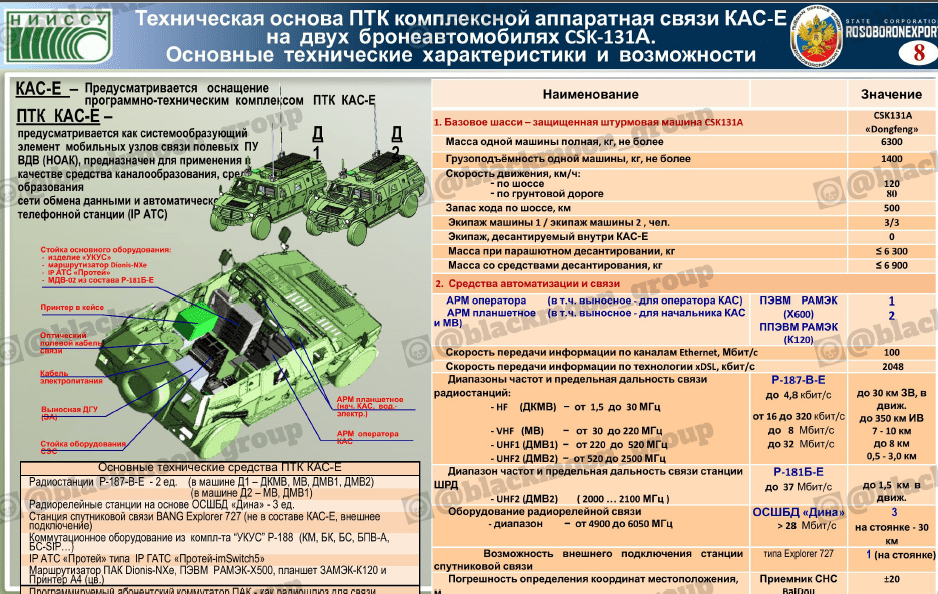
Together, these two sources suggest that Moscow is playing an active role in accelerating China’s force projection capabilities, with direct implications for the stability of the Indo-Pacific region and global military balances. INPACT discovered that another company directly connected to the PLA but not named in the Black Moon leaks was also receiving assistance from Russia. But it looks like other Chinese companies like Poly Technologies INC are beneficiaries of this programme.
Technology transfers for Poly Technologies
Poly Technologies’ entire supply chain focuses on aerospace, guidance systems, and aviation. Three suppliers stand out for the largest sales: CIAM, Technodinamika, and Concern Sozvezdeni, primarily supplying materials for technical development and technology transfer, simulators, and military equipment. Together, these three Chinese organizations account for a total of USD 207.3 million in purchases made by Poly Technologies.
CIAM – the Central Institute for Aviation Motor Development named after P. I. Baranov – is a Russian research and engineering center specializing in advanced research in aerospace propulsion, aircraft engine certification, and other gas dynamics-related issues. Poly Technologies accounts for the largest order amounts, with USD 145.5 million in imports of civilian parts for weapons systems (unspecified type) and USD 1.9 million in demonstration/simulation equipment in 2020.
Poly Technologies imported gas turbines worth USD 7.3 million, and the remainder were brochures, hard drives, and DVDs for an unidentified project worth USD 37 million from Concern Sozvezdnie, which designs and manufactures electronic warfare, radio communications, and electronic countermeasures systems and equipment.
Finally, there have been 16 shipments of equipment between Technodinamika and Poly Technologies INC since 2019, totaling USD 22,798,392. The products sent by Technodinamika are of three types:
- Turbines in 2019
- Documents for technical development, including paper and digital documents, in 2020
- Documents for other technical development and transfer of ownership, also including paper and digital documents, with radio electronic devices and test benches in 2021
- Turbines worth $14.3 million in 2024.

These transactions are all the more interesting as Technodinamika is the leader in Russia in the manufacture of aerospace equipment and specifically innovative parachute systems for airborne operations.
An active cooperation between China Poly Group and Rostec
The China Poly Group, which includes Poly Technologies, has long-standing ties with Russia. Boris Titov, an official with the Committee for the Development of Russo-Chinese Friendship, reports on the first exchanges between Rostec and the China Poly Group around 2009: “Boris Titov emphasized his extensive experience working with Russian companies, particularly with Rostec. “The first visit of a Rostec delegation to China for negotiations with the Poly Group was organized seven or eight years ago by the Russian-Chinese Business Council, which I chaired at the time. This Council is currently carrying out numerous projects in the industrial and commercial sectors. We are ready to continue our active cooperation,” during a visit to Beijing in December 2015.

A document from the “Sword” project names the key person between Russia and China.
Igor Dudukin has been the Rostec representative and chargé d’affaires for Rosoboronexport in Beijing since at least 2017.
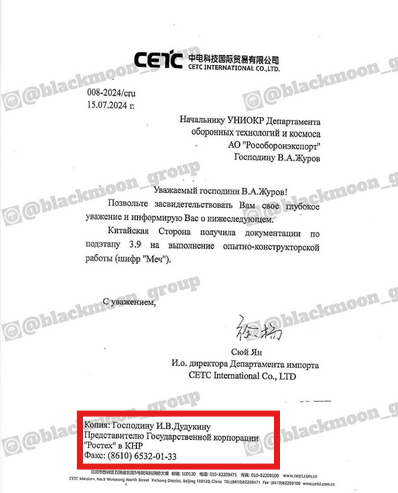

A former air force officer, Dudukin has worked at Rosoboronexport since the 2000s. He also received salaries from FINAM and Open Broker, two Russian investment firms, in 2021 for an unexplained reason.

A bigger alliance web
This cross-partnership illustrates a complementarity: China supplies Russian industry with high-tech equipment, while Russia transfers capability building blocks inherited from decades of military experience. Russia remains China’s leading military supplier. Impeding Russia thus helps delay Beijing’s offensive plans.
But Beijing isn’t limited to Moscow. In a context where international sanctions are now targeting major Chinese conglomerates, the country’s military supply chains also pass through allied countries in the Southeast Asian region such as Bangladesh and Indonesia for the acquisition of sensitive weapons and technologies, or components from Europe and the United States.
While the international community focuses on Russia or Gaza, China is quietly preparing for war. And it is its most discreet arms companies that must be watched. At the end of 2024, a rumor emerged online: a huge order for drones by the PLA had been placed with Poly Technologies INC. Unverifiable as it stands, a military blogger reports a conversation between a Poly Technologies INC employee who was forced to prioritize his other clients in order to successfully serve his client. Recently the Chinese Communist Party has expelled key members of the Central Military Commission.
 Investigations with Impact
Leave a comment