
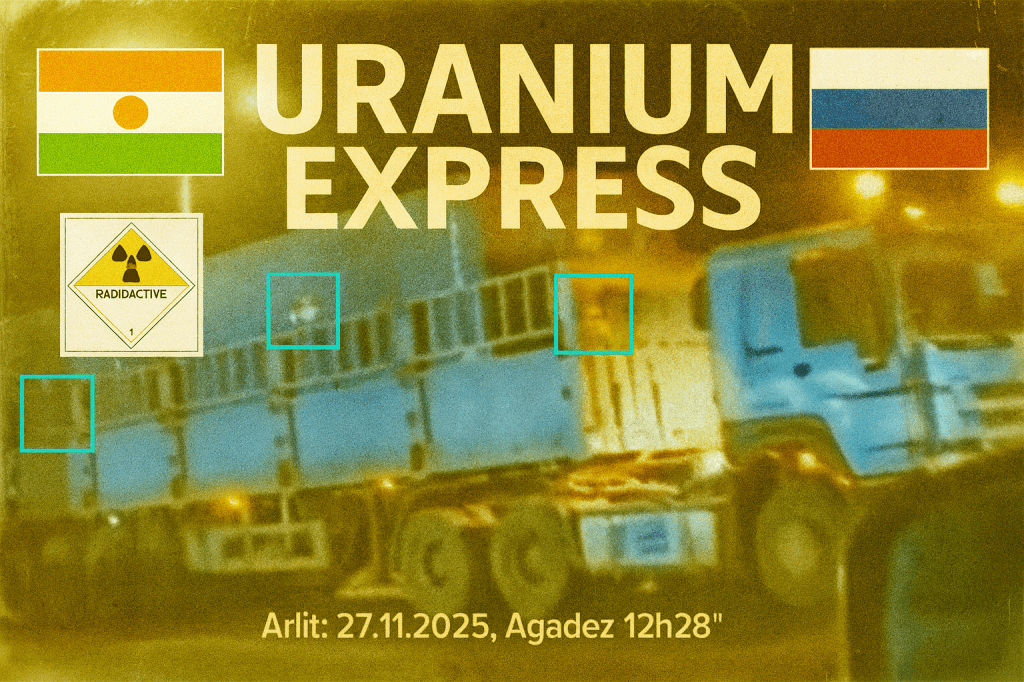
INPACT revisits what is probably the most dangerous convoy of the moment: the transport of uranium from Niger to Togo through enclaves controlled by armed terrorist groups in the region. This convoy, whose buyer has not yet been identified but is believed to be Russian, serves as a reminder that the African continent is the object of intense covetousness and that some actors are prepared to do anything to acquire highly specific minerals like uranium.
In pursuit of yellow gold
Uranium extracted from the Arlit mines in Niger has been the subject of intense controversy since General Tiani’s junta came to power in 2023. A recurring point of tension in Niger and a symbol of the past the junta seeks to erase, the junta announced on June 19, 2025, its intention to nationalize SOMAIR (Société des Mines de l’Aïr), a subsidiary 63.4% owned by ORANO (formerly AREVA). This followed ORANO’s loss of control over its subsidiary’s operations, which had been hampered by Nigerien shareholders. Since then, ORANO has been engaged in a legal battle with the State of Niger to assert its rights—particularly regarding the current stockpile of uranium produced—before the International Centre for Settlement of Investment Disputes (ICSID), a World Bank organization based in Washington.
Although the market is no longer monopolistic since the arrival of the China Nuclear Engineering and Construction Corporation in 2007, followed by Somina in 2024 and a reform of the mining code, SOMAIR is sitting on a goldmine with a reduced production of 1,130 tons of uranium per year since 2023, compared to 2,000 tons in a normal year. SOMAIR’s plant processes the extracted ore to produce sodium uranate (yellowcake, which contains approximately 75% uranium). According to ORANO, this quantity is currently blocked in the country.
It’s no wonder the company’s production is attracting so much interest and that Niger is prepared to do whatever it takes to secure a trade agreement. In 2024, Africa Intelligence revealed negotiations for 300 tons of yellowcake between General Tiani’s junta and the Islamic Republic of Iran, though these negotiations apparently came to nothing. The two countries have significantly strengthened their ties since the military junta came to power, with economic cooperation agreements signed in January 2024, followed by a defense and security agreement in May 2025.
Tiani’s sovereignist policy regarding uranium, the military regime and the impatience to sell Orano’s stocks prompted the IAEA director to travel to Niger to explore how to strengthen their partnership in March 2025, recalling that the agency “ensures safe, secure and peaceful operations while supporting this sector”.

Since the junta came to power, Russia has clearly demonstrated its interest in the country’s uranium resources. In June 2024, the Russian nuclear giant Rosatom, which is particularly active in the Sahel and also one of the last Russian strategic entities not subject to sanctions, reportedly began negotiations with Niger, according to Bloomberg. Shortly after, in July, the Turkish envoy came to plead its case for uranium supplies, potentially for power plant projects under construction, including the first one, Akkuyu, being developed by Rosatom. Then, in November 2024, Niger officially invited Russian companies, in an interview with Russian media, to express interest in uranium mining. In July 2025, Niger signed a Memorandum of Understanding with Rosatom to develop a comprehensive ecosystem related to peaceful nuclear energy in the country, encompassing everything from uranium mining to electricity distribution. Last September, at an international nuclear forum, Rosatom announced that it had received very interesting proposals from Niger regarding possible cooperation.
Uranium Express
General Tiani is visiting Arlit and Agadez from November 8th to 12th and touring SOMAIR. During his visit, he reiterated that “we do not need any authorization to sell our natural resources to whomever we want.”

As early as November 21, a video was broadcast on several platforms (X and Tiktok where it was quickly removed) showing an IL76 cargo plane present in Agadez which allegedly belonged to the transport fleet of the Russian Air Force.

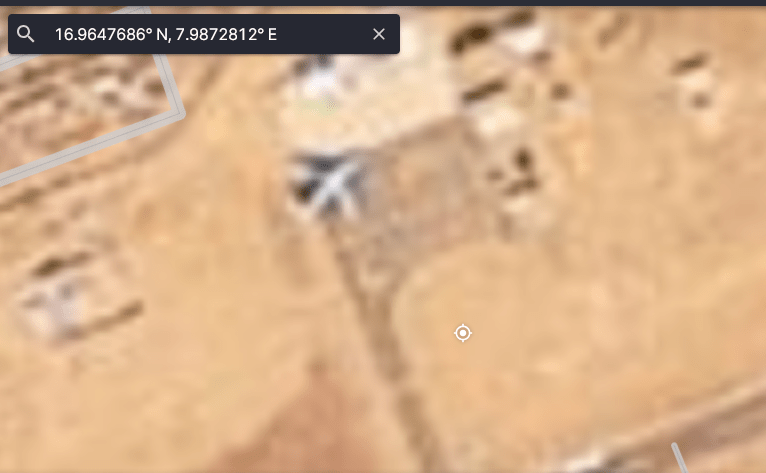
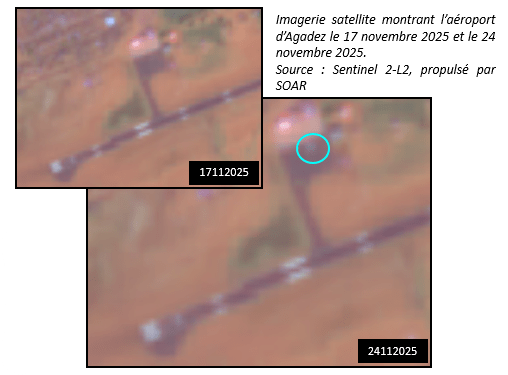
Satellite imagery shows no aircraft on the taxiway at Agadez airport on November 17th, but an aircraft is visible on November 19th and another on November 24th, though the model is not confirmed. It is not possible to verify whether this aircraft’s movements indicate the transport of Africa Corps personnel who could be used to secure the Uranium Express convoys.
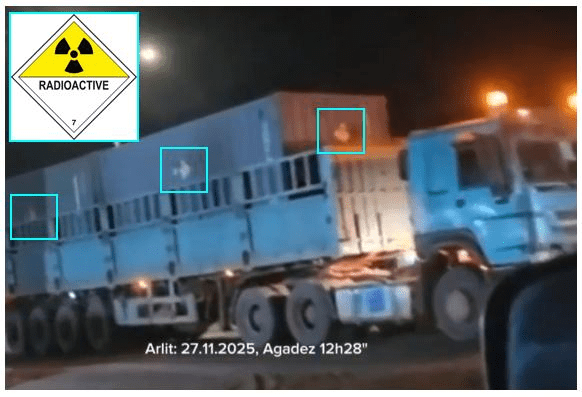
On November 28th, a video of the convoy was widely circulated and shared on several social media platforms. Filmed along the main road in Arlit leading to the Agadez road, it shows six trucks, each carrying two KC20 containers marked with the radioactive hazard pictogram. A truck without a trailer is also visible. The convoy’s passage was confirmed by a contact on the ground who witnessed it. According to several online sources and contacts, the transport company is a Nigerian firm, BM TRANS SA, owned by Baye Mohamed, which will provide 41 trucks starting November 24th, and another 13 trucks through its subsidiary, OYAM, along with two backup tractors and mechanics. The first trucks filmed arrived in Agadez on November 27th, while 12 left Arlit. Once all the trucks were gathered in Agadez, they will travel to Niamey and then Lomé, passing through Burkina Faso.
The Madmax Uranium Express cannot take the usual route for exporting uranium under ORANO’s ownership, via Benin, because the border with Niger has been closed since the 2023 coup. It will have to cross Niamey, then Gotheye and Tera, before turning towards Dori in Burkina Faso. The convoy then continues to Ouagadougou, the Burkinabe capital, then Koupéla, Tenkodogo, Bittou, and finally Cinkansé, on the Togolese border, before reaching the port of Lomé. The route will cross areas known to be occupied by armed terrorist groups (GAT). The IS-S zone extends from Tahoua to the outskirts of Niamey, while the JNIM zone extends from Kobadié to northern Togo.

The use of the port of Lomé is part of the agreement between Russia and Togo signed on November 19, 2025, which also provides for the training of Togolese military personnel, intelligence sharing, joint exercises, and the use of each other’s ports. The Russian Navy will therefore have privileged access to the port of Lomé upon the arrival of the Uranium Express convoy.
The task now is to track this exceptional convoy to ultimately determine its destination and try to identify the buyer willing to pay the Nigerien junta in cash or gold.
BM TRANS had not responded to requests for comment at the time of publication.
 Investigations with Impact
Leave a comment