

Maritime Warfare in the Houthi Era in the Red Sea
Since the October 7, 2023 massacres perpetrated by Hamas targeting Israel, a number of regional armed groups, mainly Iranian proxies, have declared their military support for the Palestinian armed organisation against Israel and the West. Among them are the Houthis, a Yemeni armed group, which now aims to disrupt commercial maritime traffic in the Red Sea, representing 12% of global maritime traffic. As early as november 2023, the Houthis launched a genuine maritime guerrilla war aiming to control and deny access to certain vessels by attacking them. This disruption of global commercial navigation has already had negative effects: increased logistical costs for safer but longer routes, higher insurance costs, abandonment by some companies of Israel as a destination to continue passing through the Bab el Mandeb Strait, increased violence against civilians, damage to infrastructure, and the internationalization of this guerrilla with American involvement in local waters and the arming of the Houthis by Iran, China, and probably Russia.

In response, on January 17, 2024, the State Department once again designated Ansarallah as a terrorist group. The decision came into effect on February 17, the date on which the Houthis announced the creation of an organisation presented as the coordination body for Houthi maritime actions: the HOCC, Humanitarian Operations Coordination Centre. Leading it, the most powerful man of the Houthi movement: Ahmed Hamed
The HOCC , A Humanitarian Deception
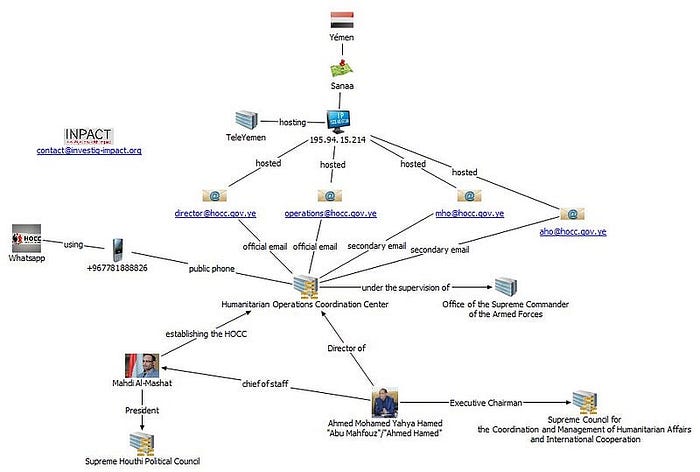
In response to American decisions, on February 17, 2024, Mahdi Al-Mashat, President of the Houthi Supreme Political Council, signed two decrees. The first concerns the prohibition of ships owned by Israeli, British, or American individuals or ships that have navigated in Israeli waters from presenting themselves in the Red Sea/Bab el Mandeb Strait/Arabian Sea. The second concerns the creation of the Humanitarian Operations Coordination Centre (HOCC). According to the decree, the HOCC is directly affiliated with the office of the Supreme Commander of the Armed Forces and has its own legal entity registered in Sanaa.
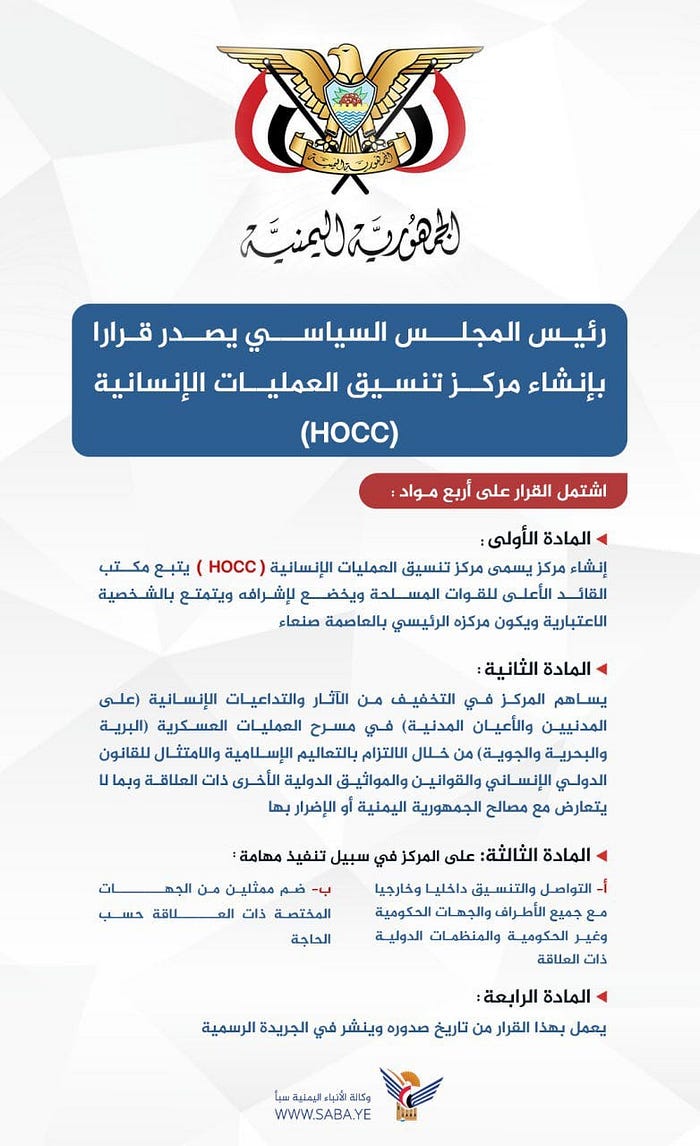
The decree outlines the objectives and missions of the HOCC. The center aims officially at “mitigating the humanitarian impacts and repercussions (on civilians and civilian property) in military theaters (land, sea, and air) by adhering to Islamic teachings and respecting international humanitarian law and other relevant rules.” The HOCC’s public missions include communication and coordination with all parties, government and non-government agencies, and relevant international organisations to enforce the navigation ban. The HOCC claims to have a maritime security mission, according to its terms. The sanctioned armed group imposes its own sanctions.
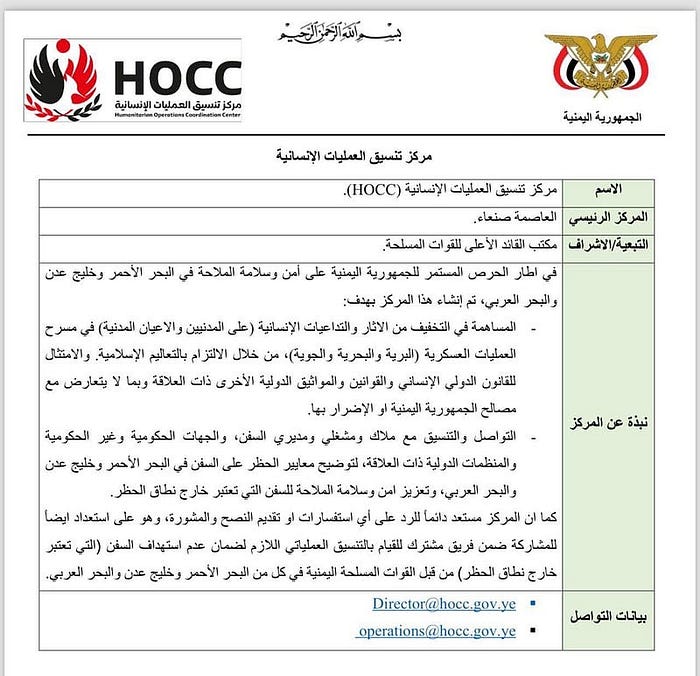
Far from the humanitarian term used in its title, the HOCC institutionalizes the maritime guerrilla conducted by the armed group. Both a guerrilla and influence operation, the HOCC has made resources available for ships to communicate directly with them (radio, phone number, and emails). INPACT believes that the HOCC’s mission is actually to target, harass identified vessels, communicate information to the Houthi armed forces and potentially negotiate passage rights with certain vessels. INPACT was unable to determine whether the HOCC contacted ships in the Strait directly by radio.
The organisation also relies on strong online communication to try to legitimize itself and gain authority: a coordinated network of social media accounts boasting the effectiveness of the HOCC in ensuring security, relaying HOCC talking points.
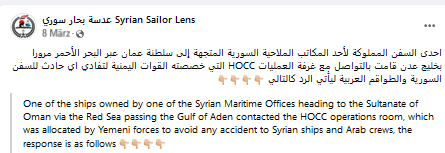
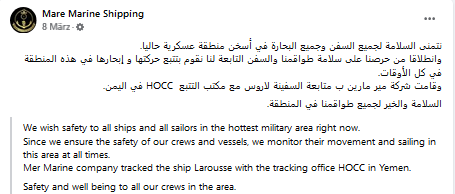
Ansarallah Media Center, the Houthi propaganda organ, even broadcasts a promotional video of the HOCC on its social networks.

The HOCC has engaged in lobbying by contacting actors in the maritime sector: shipowners, insurance companies, maritime organisations, and vessels to inform them of the navigation ban for certain ships and reassure others that ships not meeting the ban criteria will not be subject to Houthi attacks.
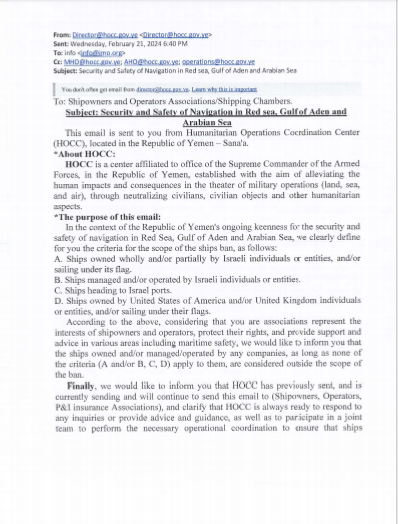
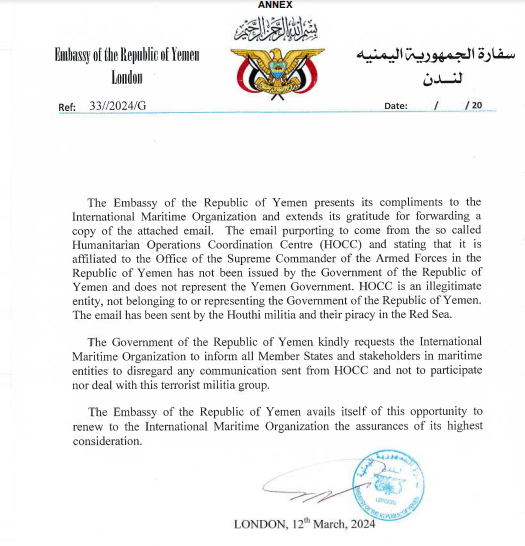
These communications have forced Yemeni authorities to issue denials concerning the legitimacy of the HOCC and its affiliation with the Houthi group.
Behind the HOCC: Ahmed Hamed, the Strongman of the Houthi Movement
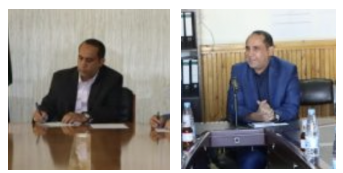
According to several open sources and human sources of INPACTwe consulted, the HOCC is headed by Ahmed Mohamed Yahya Hamed, better known as Abu Mahfouz or Ahmed Hamed.
Ahmed Mohamed Yahya Hamed is the chief of staff to Mahdi Al-Mashat. He is also the Executive President of the Supreme Council for the Coordination and Management of Humanitarian Affairs and International Cooperation. He is known as Ra’is al-Ra’is, the “president of the president” because the strategic decisions of the Houthi government are not taken without his approval. He is one of the strongest men in the country according to the 2021 report of the UN Panel of Experts. Hamed’s influence within the Houthi government is explained by his close relationship with Abdelmalek al-Houthi, the leader of the Houthi movement. While the latter is in an undisclosed location, Hamed is his man in Sanaa. Ahmed Hamed was also born in the village of Marran in 1972 like Hussein Badr al-Din al-Houthi, Abdelmalek’s brother and the founder of the Houthi movement.

The Supreme Council for Coordination and Management of Humanitarian Affairs and International Cooperation (SCMCHA), of which he is president, was created in 2019 to replace the National Authority for Management and Coordination of Humanitarian Affairs and Disaster Recovery that he already headed. It oversees the importation and distribution of all humanitarian aid in Houthi-controlled territories. The SCMCHA has adopted an aggressive and predatory stance against international humanitarian aid since its creation. In fact, Hamed introduced a 2% tax on humanitarian aid in Houthi-controlled areas in 2019. The human rights organisation, Mayyun, has documented the diversion of international humanitarian aid funds by the Supreme Council for the Coordination and Management of Humanitarian Affairs, under Ahmed Hamed, to finance Houthi fighters and their families.
Ahmed Hamed also has a history of embezzlement in his previous roles. According to the Sanaa Center, Hamed allegedly embezzled money from the Youth Welfare Fund, the General Authority for Insurance and Pensions, and transferred the Zakat Authority (tax collected in areas under Houthi control) to his office.
His appointment as head of the HOCC shows the importance of the organisation, which is de facto under the authority of the President of the Supreme Political Council and acts as a link to the Houthi armed forces. It may also indicate the HOCC’s predatory ambitions in the long term.
MO: Maritime Guerrilla
Since November 2023, the Houthis have been waging a true maritime guerrilla war, including harassment of ships by radio demanding information under threat of being targeted, taking crews hostage, using drones, destroying ships, seizing control of a maritime corridor, and endangering navigation. The list of affected ships and the modus operandi leave no doubt about their intent: a clear desire to destroy ships.
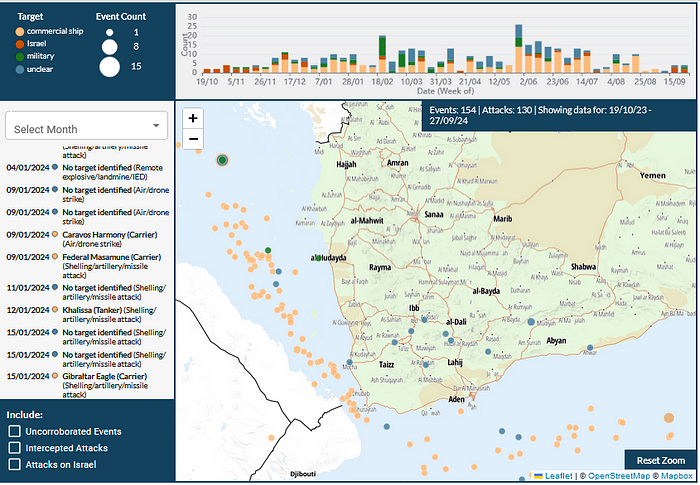
Some major shipping companies have made strategic decisions based on Houthi aggression: COSCO has stopped serving Israel while MAERSK has for the time being given up sailing south of the Red Sea.
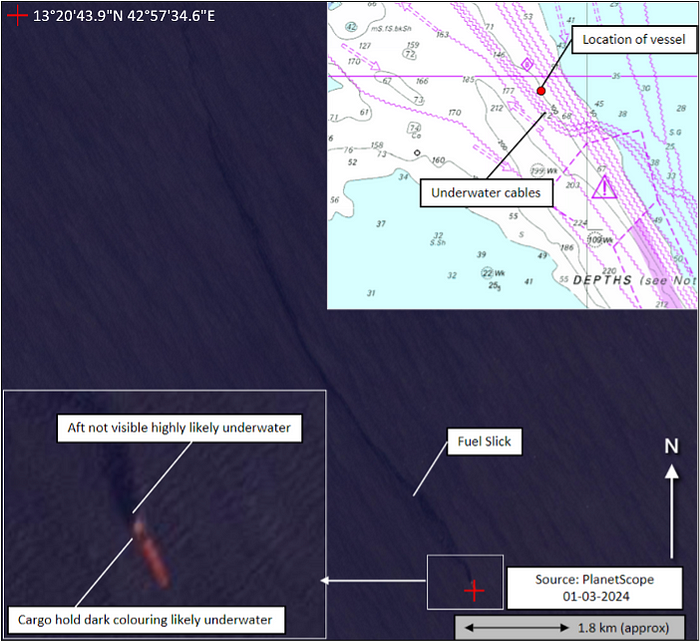
However, Houthi attacks have also indirectly impacted the submarine cable infrastructure transiting the area. On February 18, 2024, the RUBYMAR ship (IMO: 9138898) flying the Belize flag was hit by a Houthi attack while navigating the Red Sea. As it drifted for several days, its anchor likely damaged nearby submarine cables, causing a shutdown of connections.
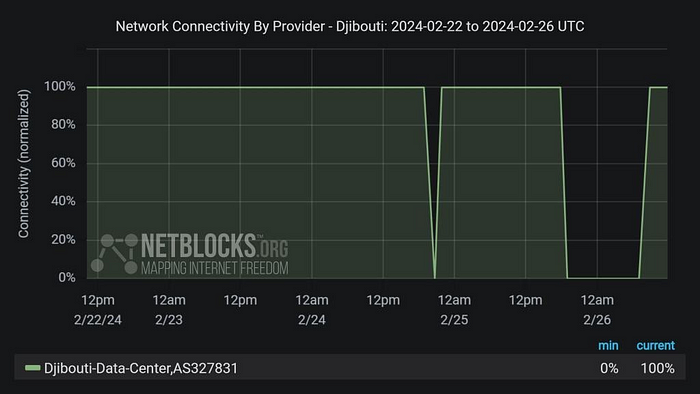
Although the Houthis deny their involvement in the cable destruction, their actions are indeed the source of the chain of events that led to this disruption of such a strategic infrastructure.
A long-term war
INPACT contacted the HOCC, which, after a preliminary exchange, refused to answer questions.
According to Mohammed Al-Basha a Washington-based Middel East security analyst, with whom INPACT had a conversation, Maritime attacks are intended to last in the long term and represent a clear opportunity for enrichment: “Houthi leadership has introduced a new demand for halting its maritime attacks: ending the war in Lebanon. There is a strong likelihood that the Houthis will continue attacking Israeli, US, and UK vessels even after the Gaza and Lebanon conflicts, seeking revenge for the deaths of Houthi-linked individuals and damage to infrastructure. One potential way the Houthis could establish a rent-seeking mechanism from maritime vessels is through the HOCC, a branch of their military and intelligence apparatus. In this scenario, the HOCC may initially charge vessels a registration fee and later require payments for safe passage by setting up a virtual maritime checkpoint at a strategic chokepoint. Since February, I have confirmed that the HOCC has been in contact with major shipping brokers, consultants, and companies, indicating that they have developed a target database. A precedent for this can be seen in the early 2010s, when companies tied to Yemeni military and security officials worked with maritime-security brokers to rent Yemeni warships and sailors as private escorts for merchant ships and oil tankers crossing the piracy-ridden Gulf of Aden, at costs reaching up to $55,000 per ship, per trip. The Houthis could replicate this model to generate revenue by providing security to major oil tankers through affiliated firms. In any case, instability in the Red Sea under Houthi control is unlikely to end soon”.
Furthermore, the HOCC and its leader are not on international sanctions lists, although the designation of the Houthis as a terrorist group by the United States limits what the HOCC can do.
 Investigations with Impact
Leave a comment