
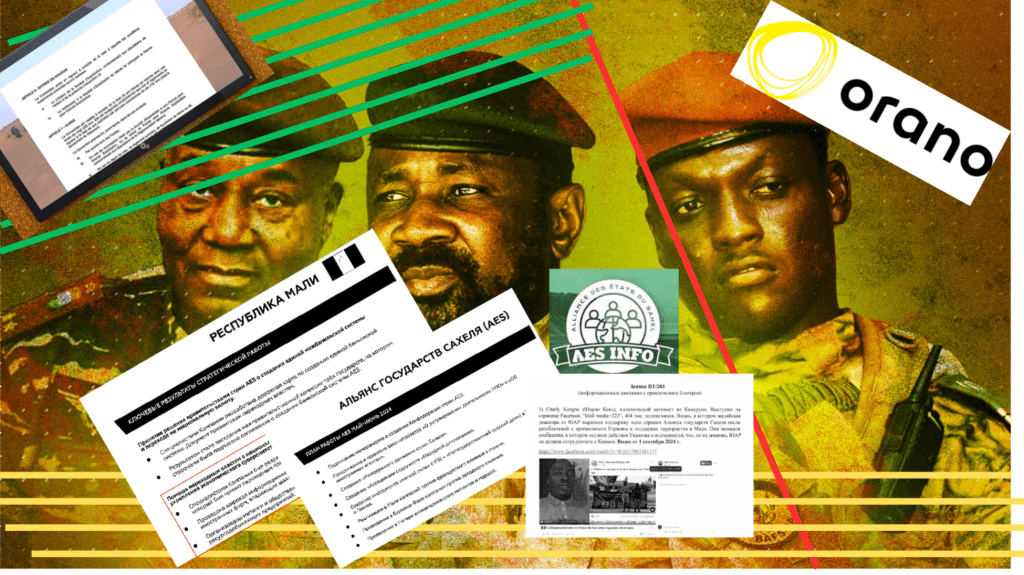
“Well, hello Mali”. The post published on the famous Russian Grey Zone channel on 25th September 2021 is illustrated with a photo of a van on which several people are sitting along with plastic chairs riding a red track. The Wagner group’s presence in Mali will only be confirmed on December 23rd 2021 according to satellite imagery. Deemed “the locomotive of the Sahel” in 1400 pages of leaked documents received by the Continent and examined by a media consortium, Mali remains a strategic focus and priority for the SVR controlled-network, Africa Politology, in 2024. This new episode lifts the veil over Africa Politology’s strategy in the Sahel. As the contractors claim the creation of the Alliance of the Sahelian States (AES), the reality of their strategy, often conveniently perceived as relentless and aggressive by Western governments, is more nuanced in terms of achievements.
Ideal conditions for Russia
The arrival of the Wagner Group in Mali was preceded by months of civil movements demonstrating against France and the Barkhane Operation. The country was ripe for change with populations exhausted by unsolved growing insecurity and the accumulation of collective resentment for elites perceived as puppets of the old colonial power. By supporting these unaccountable political regimes perceived as highly corrupted and failing to solve the spread of regional jihadist insurgencies, Western countries, with France in the first place, were called into question and seen as illegitimate. A situation which Russia has largely leveraged with the objective to intensify it, accelerate it and amplify it.
In January 2021, Yerewolo Debout sur Les Remparts, a pan-African NGO, called for the departure of French troops and the end of Operation Barkhane. Yerewolo was led by Adama Ben Diarra, alias Ben le Cerveau (Ben the Brain), who was the ex-leader of M5-RFP. The organisation was supported by Kemi Seba, a prominent pan-African figure who has had documented close ties with the Russian government and has been used in the past by Evgeny Prigozhin’s team to influence African countries. On March 26th, Yerewolo called for military cooperation with Russia, before Colonel Assimi Goita’s coup in May 2021. Another Wagner affiliated entity, The Foundation for the Protection of National Values has conducted and published surveys on Mali since the May 2nd military coup, showcasing opinions in favour of Russian intervention and a very negative perception of the French military’s Operation Barkhane.
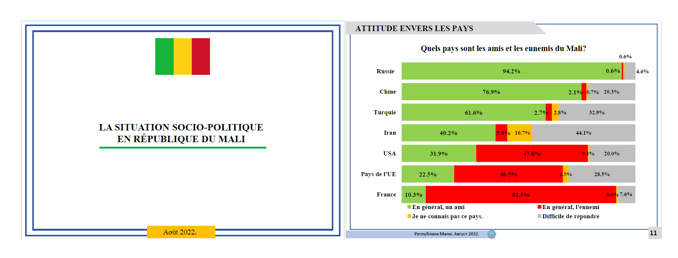
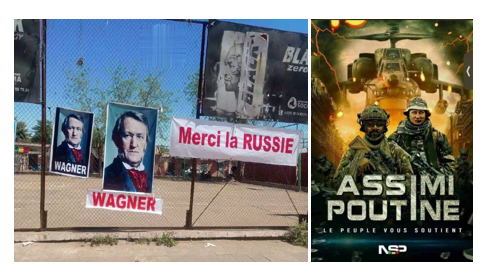
Following Colonel Assimi Goita’s accession to power, efforts continued to influence the perception of local populations in favour of an alliance with Russia and, in turn, to support the arrival of Wagner mercenaries. This was accomplished through anti-French demonstrations, influence operations against France, and pro-Junta social media campaigns.
Bold Strategies, More Nuanced Realities
Overall, the documents produced by Africa Politology are striking by the bold claims which are made in terms of achievements. They do not shine by an in-depth understanding of local dynamics and sometimes the same objectives and recommendations are attributed to several countries in the same region without a tailored approach to local peculiarities. To their masters in Moscow, Africa Politology’s work seems immensely successful, but the reality on the ground and the conditions necessary for changes are much more nuanced and require a multitude of actors and mechanisms to actually happen.
“Keeping Mali in the Russia’s sphere of influence” and “Legitimasing Assimi Goita”
In Mali, the objective is blunt. The strategy document mentions that the objective to reach is “keep Mali in Russia’s sphere of influence”. The document outlines then the measures which the team needs to take to achieve this goal: “it is necessary to support the current authorities and conduct a complex set of measures for increasing legitimacy and international recognition”. A language which in practice centers on securing a legitimate mandate for Assimi Goïta.
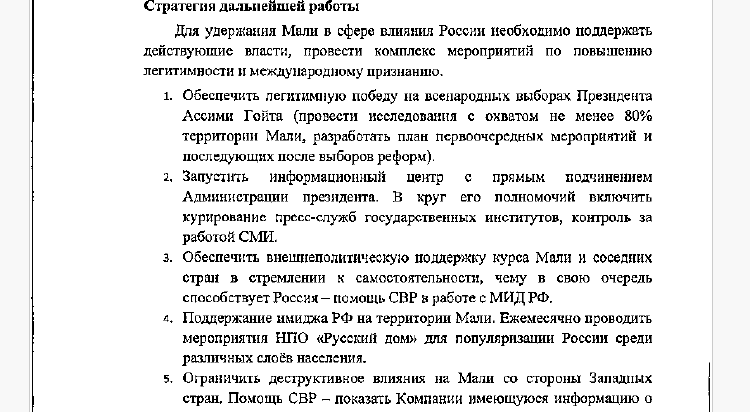
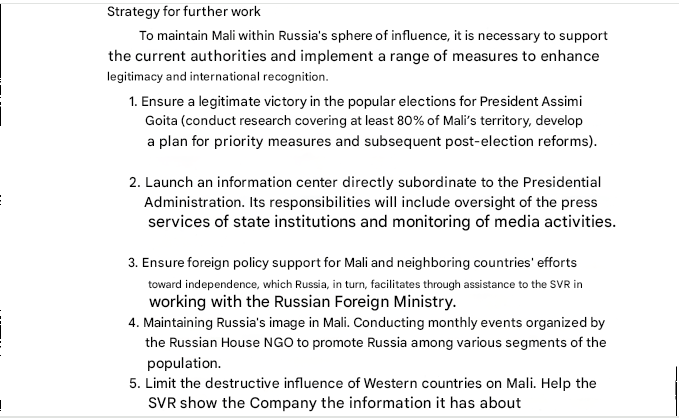
The plan proposes the organisation of a nationwide research covering most of the country’s territory, the design of priority policy measures and a package of post-election reforms — all aimed at ensuring what it describes as a “legitimate victory.” for Assimi Goita. Parallel to that political track runs a media strategy: the creation of an information center directly subordinated to the presidential administration, with authority over state press services and oversight of the broader media environment.The SVR is mentioned as assisting in coordinating diplomatic backing for Mali’s chosen course, while helping frame Bamako’s posture — and that of its neighbors — as a sovereign push for independence from Western tutelage. At the same time, Moscow would try to disrupt attempts by Western countries – or what they call “destructive influence”- to rebuild ties with Mali by obtaining intelligence about French and US plans for military or political engagement in the Sahel.But this strategy prepared in August 2023 did not go as planned and there is no information on how Africa Politology adapted to the course of events. Instead the junta took a more authoritarian turn. In September 2023, the elections supposed to take place in February 2024 are postponed without any date announced. In December 2023 the Observatory for the Elections and Good Governance was dissolved. In April 2024, Colonel Abdoulaye Maïga announced the dissolution of political parties following a nation-wide consultation.
Burkina Faso: new era but same objectives
During the Prigozhin’s era, there were no boots on the ground in the country but Russian campaigns were in full swing for the arrival of IbrahimTraore in power. Burkina Faso became the country to launch Africa Corps and project a strong relationship. In the country, Africa Politology’s objectives are quite similar to the ones in Mali: discrediting France, supporting Ibrahim Traore for the upcoming elections and internationally, boosting Russia’s image in the country.
The plan proposes as well “establishing an information center to address social sentiment.
This could be done in the Republic of Mali. Conducting sociological research and adjusting sentiment”. While there was hesitation for a while among analyst communities about the geographic origin of some information campaigns involving Burkina Faso, it seems the Company got this part of their reporting correct. An intense propaganda machine has been put in place under Captain Traore, starting with the BIR-C, an information bataillon. The GPCI network is also going to remain active for Burkina Faso before targeting other countries like Niger, Togo or Guinea, targets for Russia’s expansion. The degree of involvement of the Russian consultants in setting up and supporting these networks is unknown. The noise they can make needs to be also put in perspective with the void in which they operate. Censorship imposed by the junta and threats on local media, journalists and international media have been the determining factor for the propaganda machine to successfully deploy. In this context, are opinions genuinely shaped?
Niger: blocking all type of dialogue with the West
In Niger, where General Abdourahamane Tchiani seized power in 2023, the strategy is even more explicit. Africa Politology’s mission is to keep Niger away from the US and the West. The objective is specifically to block any meaningful dialogue between the new authorities and Western capitals and ensure that external pressure in the media- highlighting tensions with the West and how the West is pressuring the junta – keeps the junta anchored in partnership with Russia rather than drifting back toward Europe or the U.S.
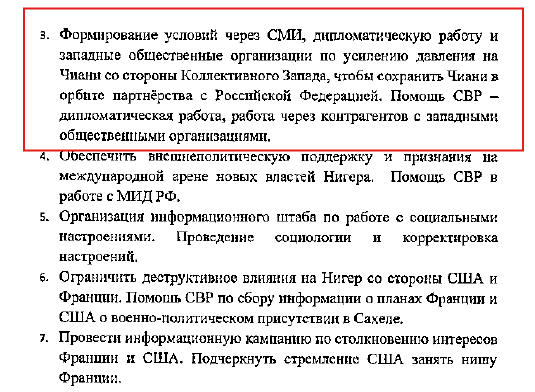
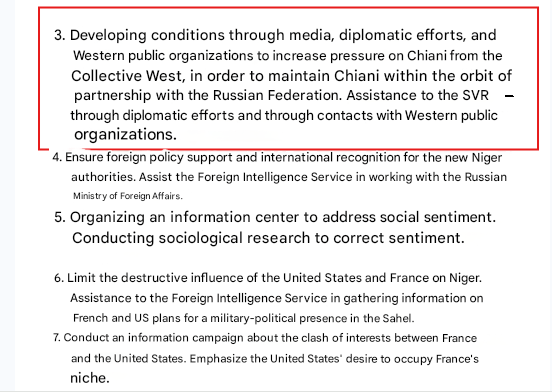
Yet, Africa Politology fails to contain the eagerness of Turkey to develop business and relationships in the three countries or the US to make their come-back with the new administration with a more pragmatic and transactional approach. Can Russia maintain an edge if the diplomacy of dollars is fine with military authoritarian regimes?
Where is the cash?
One key element comes back in the strategy designed for Mali and Niger: access to natural resources. In the strategy designed for Mali in 2024, the Company congratulates itself to be at the origin of a successful lobbying to change the mining code. In some more operational documents, the Company has noted down “A large information campaign has been conducted to discredit foreign companies which are owning mines. Demonstrations in favour of the nationalisation of extraction industries have been organised. Contracts with Western, Turkish, Chinese and Australian companies are currently being revised”.
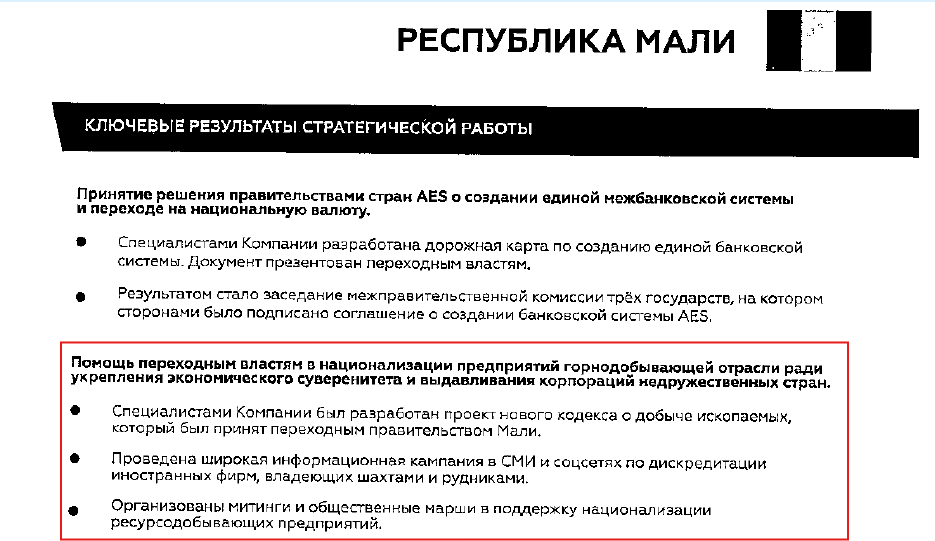
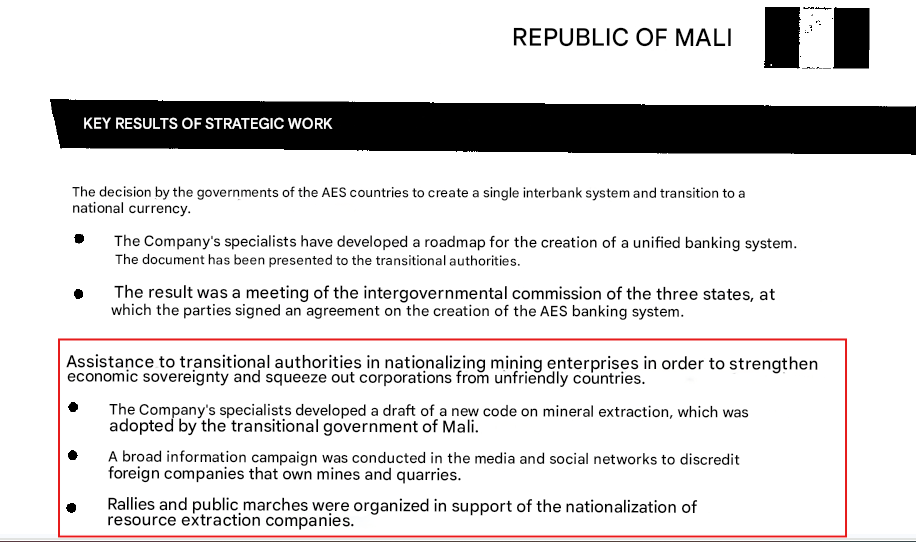
Is it to satisfy the bosses back in Russia who may be under pressure to find cash and new financial routes circumventing sanctions? In reality, two ex-Barrick Gold employees can instead be credited for the strong crackdown on Foreign mining companies in Mali, including the arrest of Canadian Barrick Gold’s and Australian Resolute Mining’s key employees. Through Iventus, their small consultancy, the two ex-employees won the audit of the foreign mining companies which led to revision of the mining code in 2023 and the renegotiations of the miners’contracts. These higher tax collection rates banked by the Malian government are still benefiting Russia which can invoice their security support amounting to 10 million usd per month. But they remain like a supplier dependent on their client willingness and ability to pay. The reality is even starker. Russia has been struggling to get any meaningful project off the ground in the country and has been more involved in illicit mining. Their gold refinery project which could have put them in a negotiating position with foreign companies has stalled.
The situation is similar in Niger. Africa Politology dwells on how their campaigning work has led the authorities to remove Orano’s mining permit.
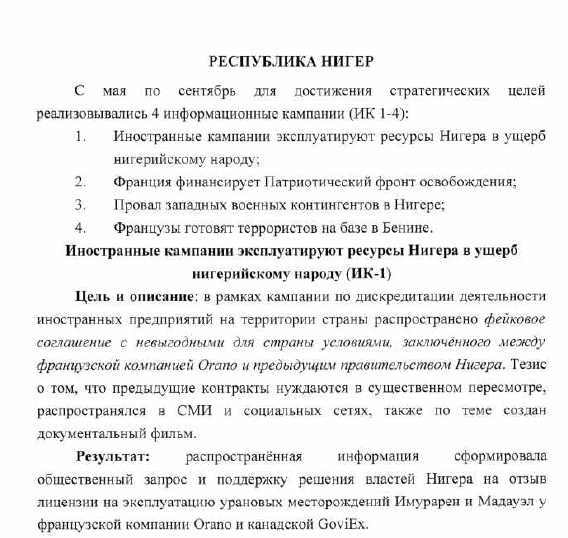
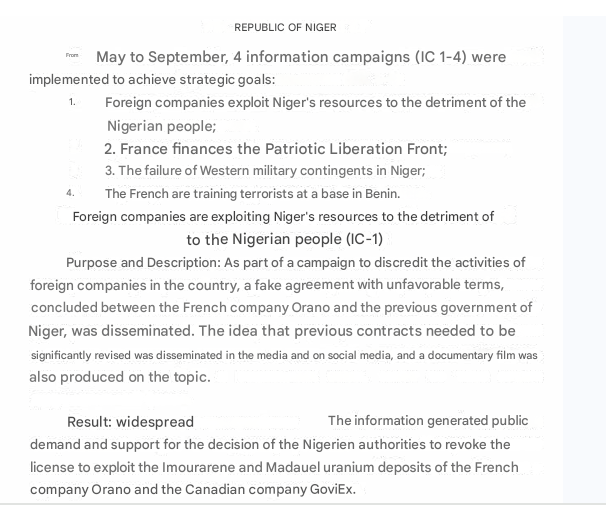
The Company is claiming that one campaign propagating a fake agreement between Orano and the State of Niger with a clause stating the contract needs to be renegotiated every 10 years is at the origin of the government’s decision to revoke Orano’s mining licence. While the sequence does appear in a documentary of the national channel, it is bold to assume that a few seconds have been a game changer in the political action of the government.
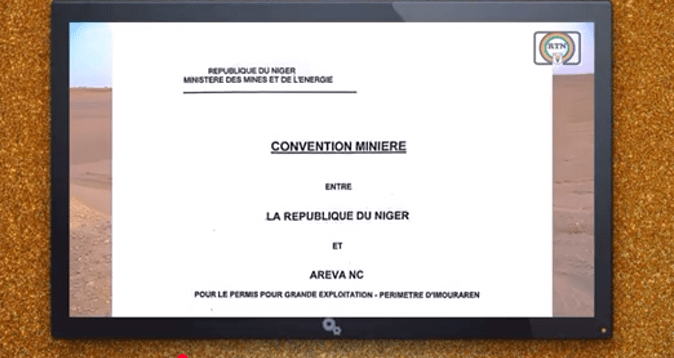
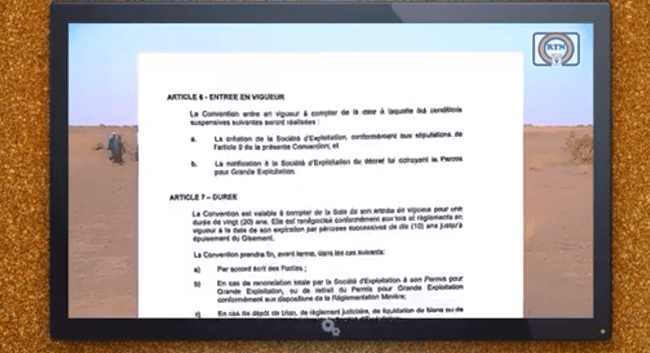
One can wonder if Africa Politology is trying to fool their SVR bosses or whether they are taking Nigeriens for gullible people as the presence of AREVA/ORANO has been criticised for years with recurring tensions. Even after Orano’s licence revocation in June 2024, Russia struggled to close the deal.
Contrary to the Central African Republic where the Wagner group was able to gain access to businesses and mining titles, the Russians have been struggling to replicate the same achievements in Mali and elsewhere since 2021. In countries Russia has had established mining operations, sanctions have disrupted their ability to move and sell their resources.
At the inception of the Alliance of Sahel States (AES): the ultimate claim
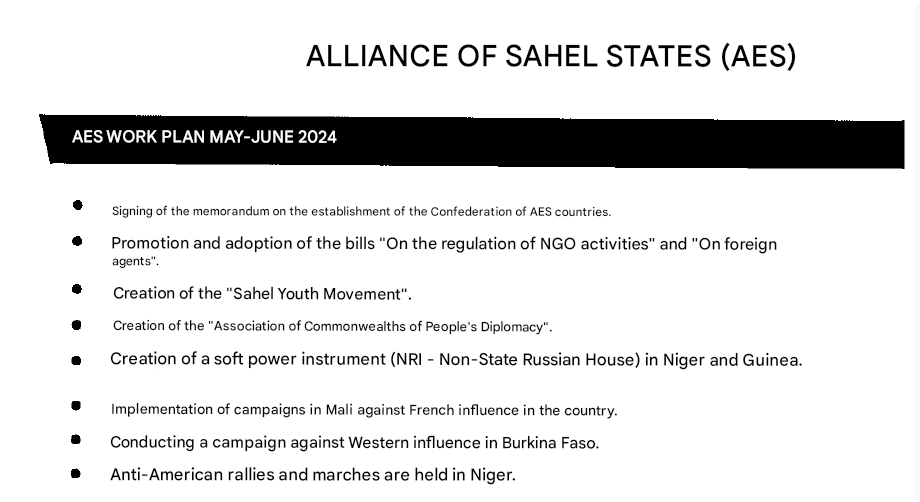
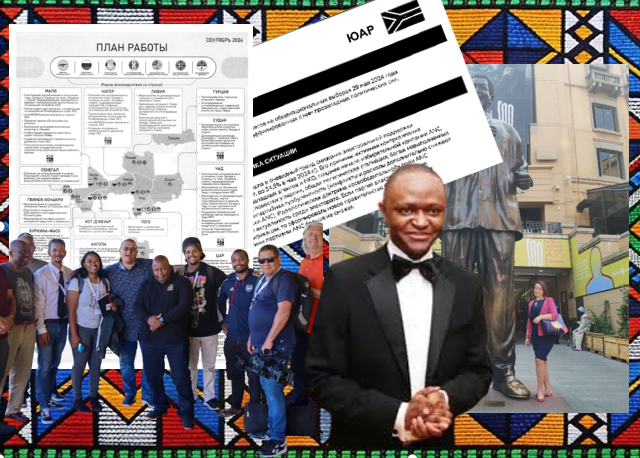
Yet, Africa Politology’s biggest claim is to be behind the creation of the Confederation of the States of the Sahel. From a strategy document dated of January 2024 obtained by Forbidden Stories, the goal is to establish an anti-Western belt of countries “from the Atlantic Ocean to the Red Sea”; which would support Russian foreign policy. The AES as a strong political entity is critical to achieve this vision. In addition, Africa Politology recommends to discredit the US as well as international Western NGOs with operations in the Sahel citing the International Foundation for Electoral Systems, Chemonics (a US contractor which has managed historically a significant portion of USAID funding through local operations), Amnesty International and Human Rights Watch, the International Republican Institute (focusing on promoting democracy and good governance practices) and “others”. The goal is to disrupt their operations, make them seen as “toxic” and get them “labelled” in Sahelian countries.
While the leaked documents seem to be drafted in 2024, the Company mentions its early involvement in spinning the idea of the AES. One document dated of July 2024 describes early discussions about the project between high level state representatives of Mali and Burkina Faso in late 2022. Some known Malian names appear. “In November 2022, during a visit of a delegation from the Republic of Mali to the Russian Federation, a meeting took place between a Company representative and the Chief of Staff of the Air Force, Alou Boi Diarra, and the special representative of the President of the Republic of Mali, Adama Bagayoko. The Malian delegation discussed prospects for joint relations with the transitional authorities of the Republic of Burkina Faso. In December 2022, a delegation from the Republic of Burkina Faso, led by Prime Minister Apollinaire Joachim Kyélem de Tambèla and the President’s special representative Captain Sorgho Traoré, arrived in the Russian Federation. A meeting with Company specialists took place through the mediation of the special representative of the President of Mali, Adama Bagayoko. At this meeting, the proposal to create a confederation of the two countries was conveyed to the Burkinabe side. The Prime Minister received the proposal positively, stating that “only in this way can they preserve their traditional values,” asked for comprehensive support from the Russian Federation, and promised to definitely discuss the proposal with President Traoré”. Alou Boi Diarra and Adama Bagayoko are no strangers. They were actually sanctioned by the US Treasury until recently for their role in promoting the Wagner Group in Mali. According to the notice published in July 2023, Adama Bagayoko has also served “as an advocate for the Wagner Group to the Burkinabe transition government, working to secure the Wagner Group’s deployment to Burkina Faso”. For the Russians, Mali is the driving force of the project.
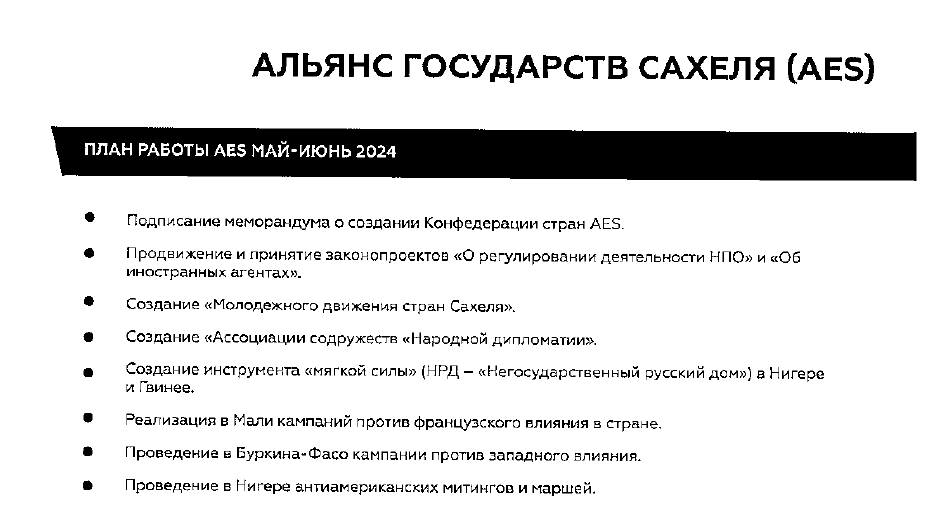
In several documents, the Company explains they work by drafting key recommendations on a number of topics to conceive a political structure and by crafting campaigns to promote
a positive image for the AES, joint military operations and against the CFA franc through media campaigns, activist movements, networks of influence agents and events.
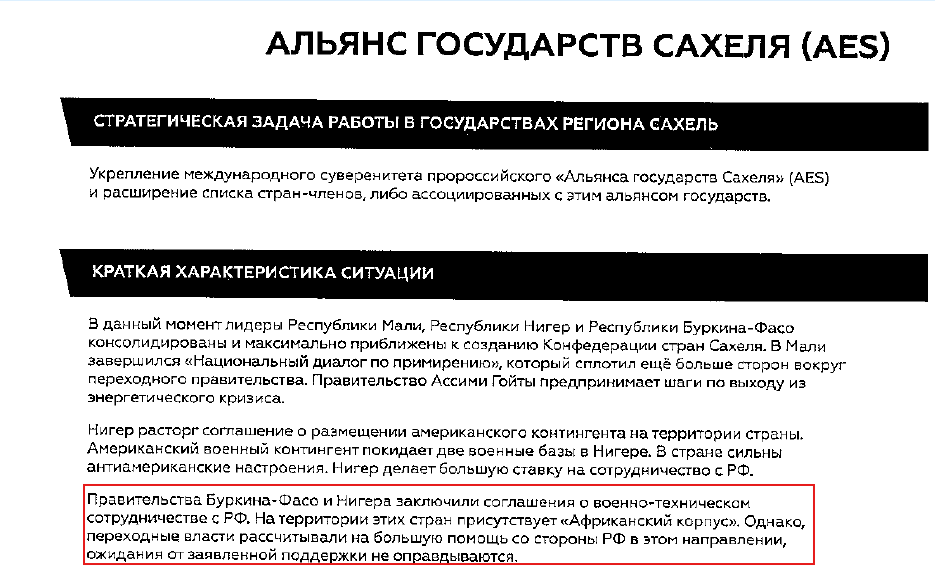
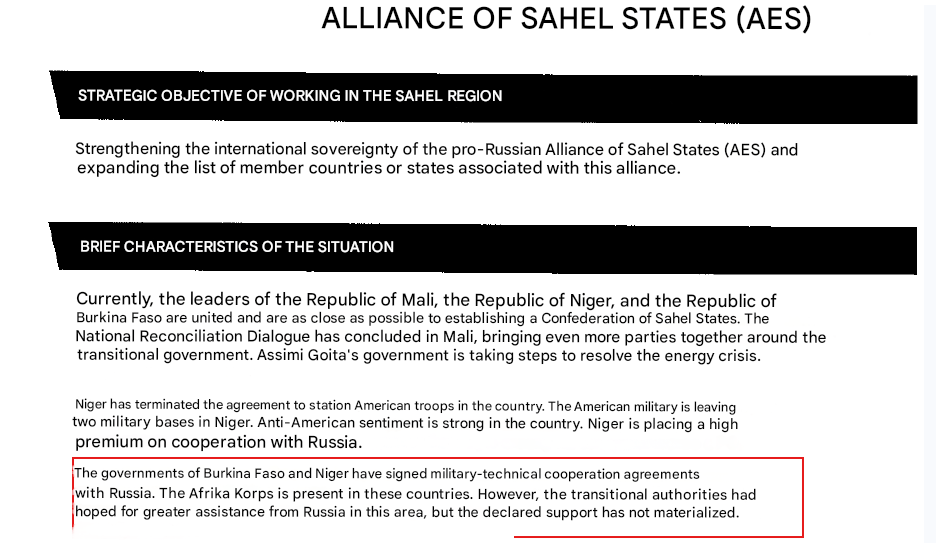
Yet an undated powerpoint presentation circa mid-2024 reports already some disappointment from Burkina Faso and Niger: the two countries expected more support from Russia on the military side with the arrival of Africa Corps. The author of the presentation writes that the support did not materialise.
INPACT/AEOW consulted several Malian and European experts who all agreed on one point: Russia cannot be on their own at the inception of the AES. Multiple local actors and multiple circumstances have led to this project. According to Julien Antouly, Assistant Professor in International Public Law at Rouen University, “The AES project was anticipated and prepared by the Malian authorities themselves. The sanctions imposed on Mali by ECOWAS in January 2022 served as a catalyst. Attempts to negotiate with ECOWAS took place, without success. As early as the end of 2021, the Malian authorities had even expelled the ECOWAS ambassador. A counter-diplomatic summit was organized by the countries under ECOWAS sanctions (Mali, Burkina Faso, Guinea) to demonstrate the possibility of an alternative to the sub-regional organisation. The determining factor that led to the creation of the AES was the threat of armed intervention by ECOWAS in Niger, in response to the coup d’état that occurred in July 2023. The AES Charter was signed a few weeks later”.
A year later, the confederation project emerged, marking a change of scale. The focus shifted from a strictly security-oriented approach to a dynamic of regional integration, encompassing political, economic, and diplomatic dimensions. While Russian influence may have played a role by encouraging the transformation of a defense alliance into a more structured regional political organisation, Antouly warns that it would be a mistake to only see the Russian hand behind it.
Showing some value for money to the SVR
As of late 2023, the AES gets social media profiles which have declinations in the three countries and relies on influencers close to Russia as well as bloggers whose work appear in the leaked documents. With that at hand, Africa Politology can surely show to the SVR they are delivering on their strategy.
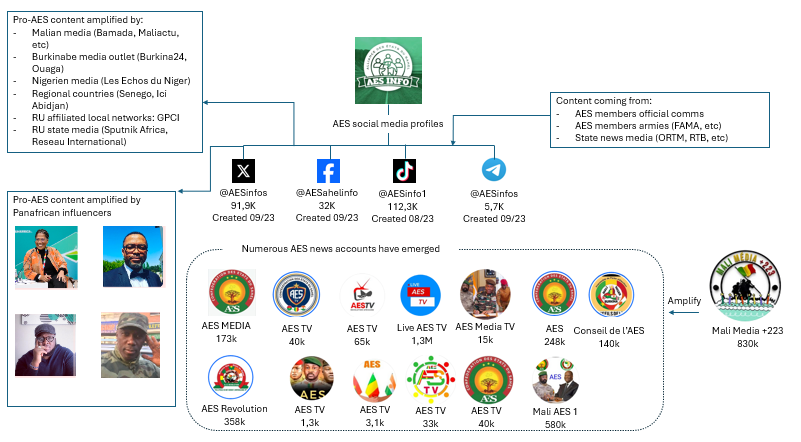
Content is amplified or packaged by Mali Media+223, a Facebook page with more than 830k followers. Established in Mali, the account is often inviting known bloggers and influencers on its page. The account is heavily featured in the leaked documents with 18 pages documenting a blogger campaign. Contacted by the media consortium, the page admin, David Diarra, denied being paid for his content and declared he did not have any contact with Russian consultants.
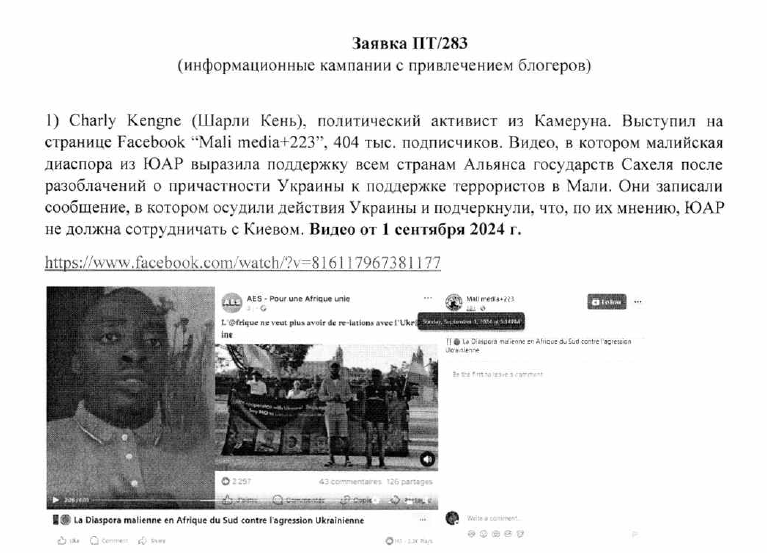
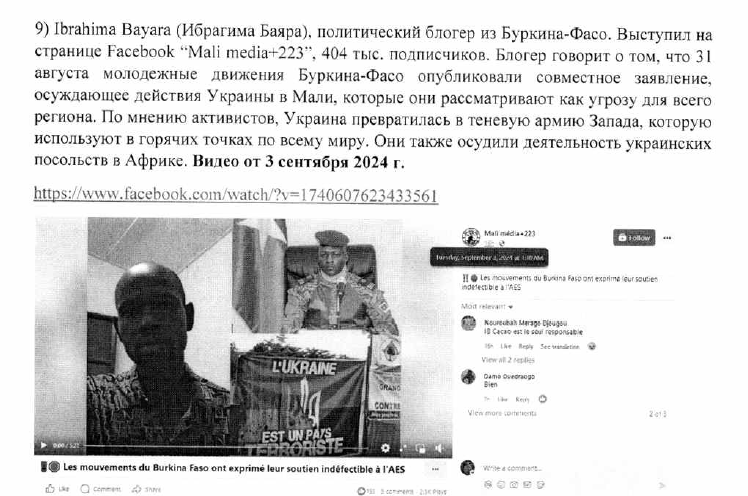
The infrastructure reminds of a 2.0 reboot of Malian videomen. Often manned by single individuals or small teams, they are easy to scale and manage as a network. Along with sponsored articles in local media, Africa Politology can give the impression of flooding the information space with messages promoting the alliance and Russia while discrediting Western countries. It gives Africa Politology some material to show there is some value for money in the evaluation reports they send to their bosses in Moscow to request more budget while demonstrating to their client that everybody is talking about them online.
Behind the smokescreen lies a reality: Africa Politology is limited in its power and actions. Skilled at surfing waves, the network has been able to blur lines and results by claiming big wins which have a more nuanced history. But Africa Politology appears powerless no matter how many strategies and relentless campaigns are produced when one of the local driving forces decide to change the course of the plan. The latest discussions between Mali and the US are a prime example of the strong drive local actors can give to their own trajectory as well as the recent announcements of Ghana’s government to restart talks with the AES countries and ECOWAS to find a mid-way solution. Perhaps the Russian consultants are now experiencing the reality of their own messages: African countries ultimately possess the agency to select their own partners.
 Investigations with Impact
Leave a comment